Plywood vs MDF vs MFC: what is inside your kitchen?
Different boards suit different jobs. Understand the core, the finish and the construction before comparing a kitchen quotation.
The practical answer
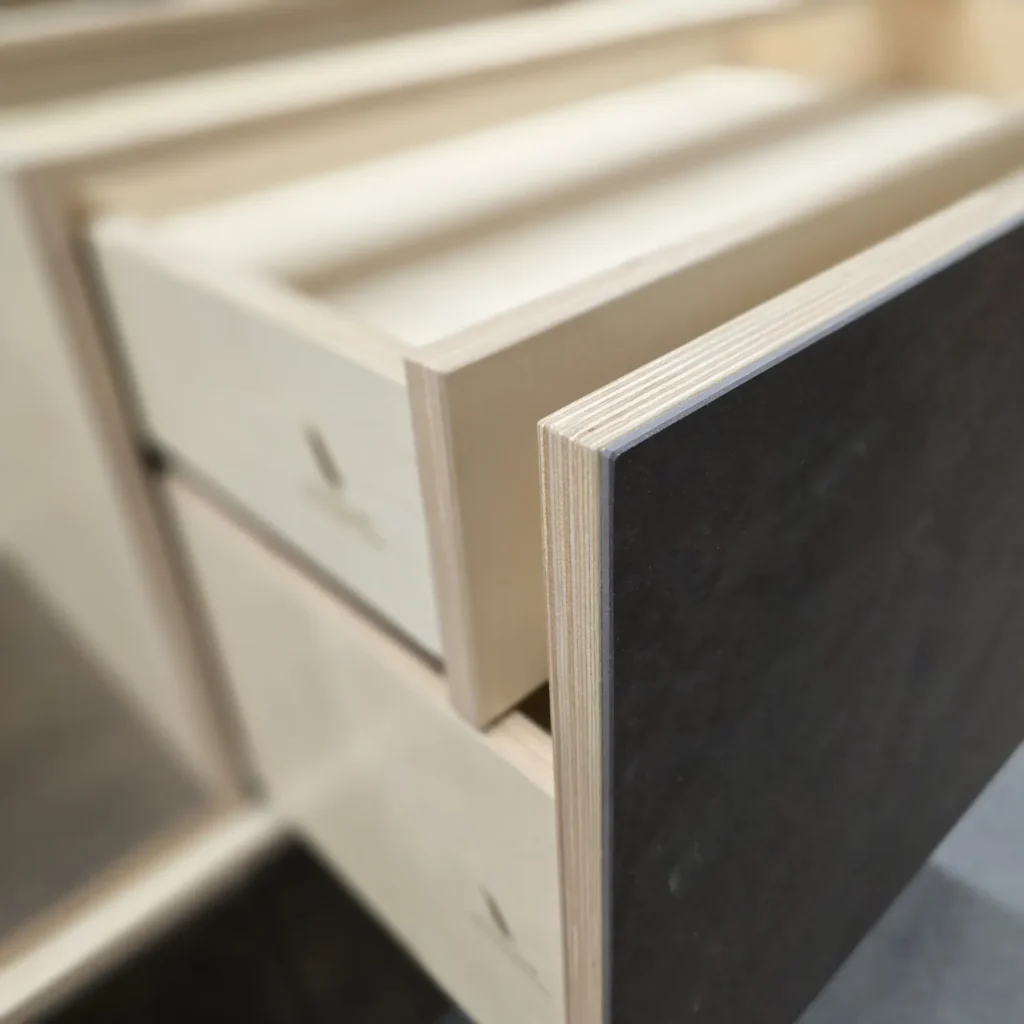
Plywood suits robust cabinet construction and exposed layered edges. MDF offers a smooth, consistent substrate for painted or routed fronts. MFC provides a ready-finished decorative surface for efficiently made cabinet components. The right choice depends on the component, board grade, detailing and budget.
A premium-looking surface does not reveal the board underneath it. No material name, on its own, guarantees a better kitchen.
Compare plywood, MDF and MFC
Start with what each material does well. The comparison describes material categories; check the specification of the actual product proposed for your kitchen.
Look beneath the surface
Plywood
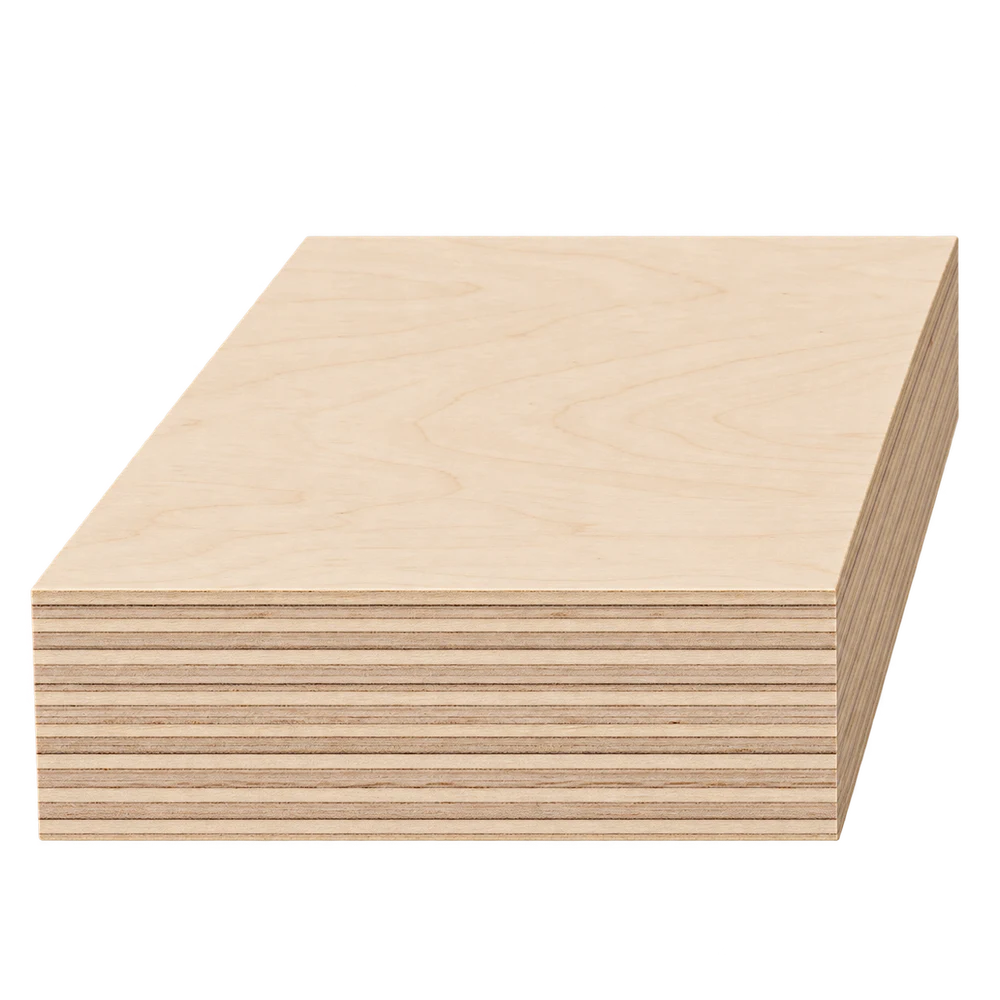
Bonded wood veneer layers, normally arranged with alternating grain directions.
MDF
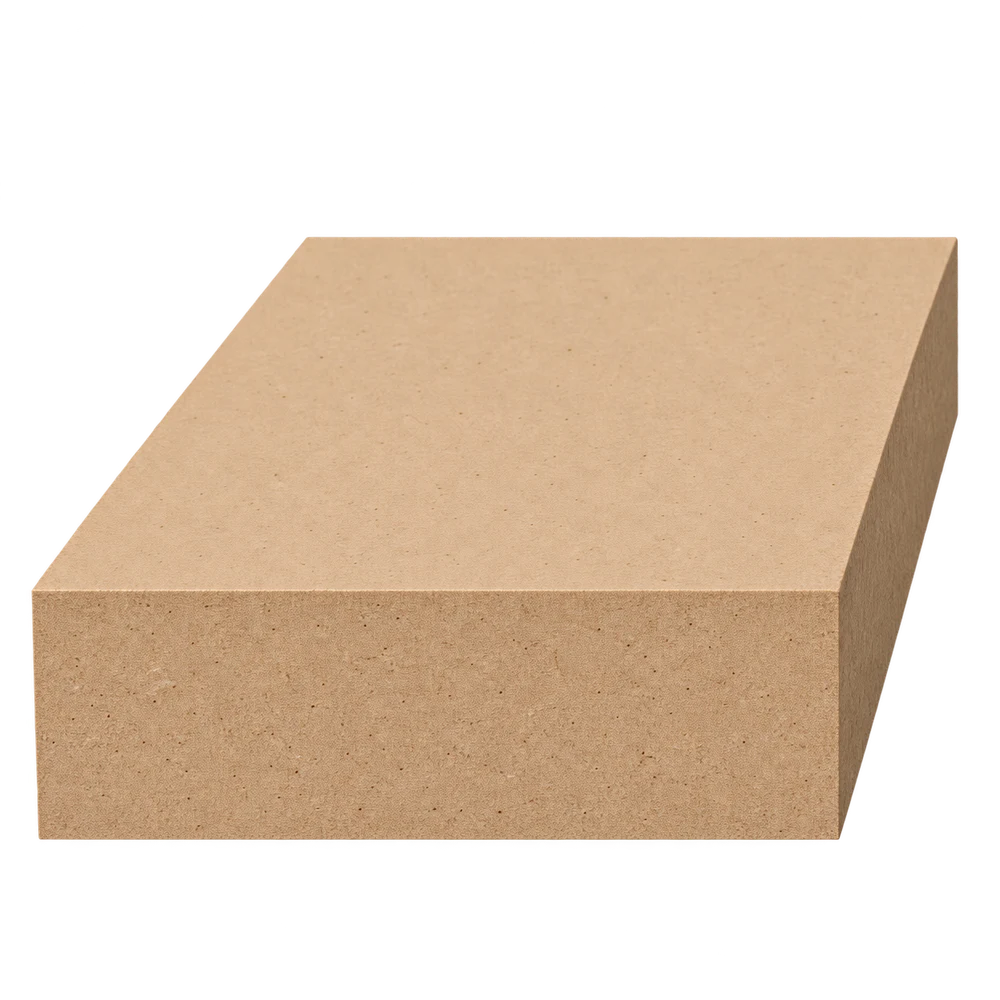
Fine wood fibres pressed with resin into a dense, consistent board.
MFC
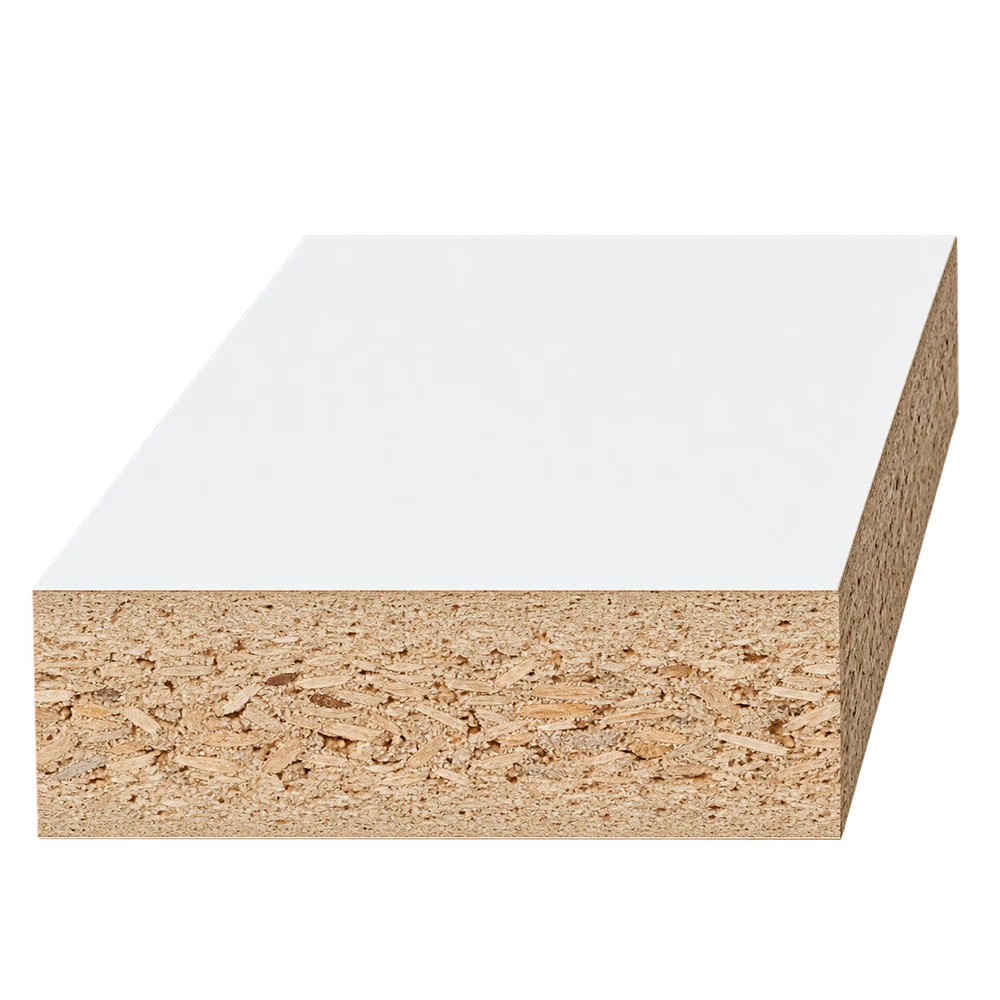
A chipboard core with thin decorative melamine faces on the top and bottom.
Illustrative cross-sections. Grades, finishes and construction vary. Select a sample to view it full size.
On smaller screens, swipe the table sideways to compare all three materials. Keyboard users can focus the table area and use the arrow keys.
| Consideration | Plywood | MDF | MFC |
|---|---|---|---|
| Construction | Multiple layers of wood veneer bonded together | Dense board manufactured from refined wood fibres | Particleboard core with factory-applied melamine faces |
| Particularly suited to | Carcases, drawer boxes, shelves, structural components and exposed edges | Painted fronts, routed details and components requiring a smooth substrate | Prefinished cabinet components and cost-efficient interior applications |
| Visible character | Layered edge can become part of the design | Normally painted, veneered or otherwise finished | Available prefinished in a wide range of colours and decors |
| Moisture performance | Depends on plywood type, bonding specification, finishing and edge protection | Standard and moisture-resistant grades are available | Standard and moisture-resistant particleboard grades are available |
| Useful question to ask | What type and grade of plywood is being used? | What MDF grade and finishing system are being specified? | What particleboard grade, edge treatment and construction are being used? |
MFC describes a faced product: its core is particleboard and its surface is melamine. Plywood and MDF can also receive decorative finishes. Comparing only the face material can therefore miss the construction underneath.
Surface, core and construction
Two kitchens can share similar colours, handles, worktops and door finishes while using different cabinet materials. Separate the specification into three parts:
- Surface: what you see and touch
- Veneer, lacquer, decorative laminate, FENIX, melamine or ceramic. A finish alone does not identify the core.
- Core: the board beneath the surface
- Plywood, MDF or particleboard. Doors, carcases, shelves, backs and drawer boxes can use different boards within the same kitchen.
- Construction: how it is put together
- Joints, edge protection, fixings, hardware, assembly and installation. These affect performance alongside the board itself.
A visually simple cabinet can contain a carefully specified construction, while an expensive finish can cover an economical core. Ask for the full specification rather than trying to judge it from a photograph.
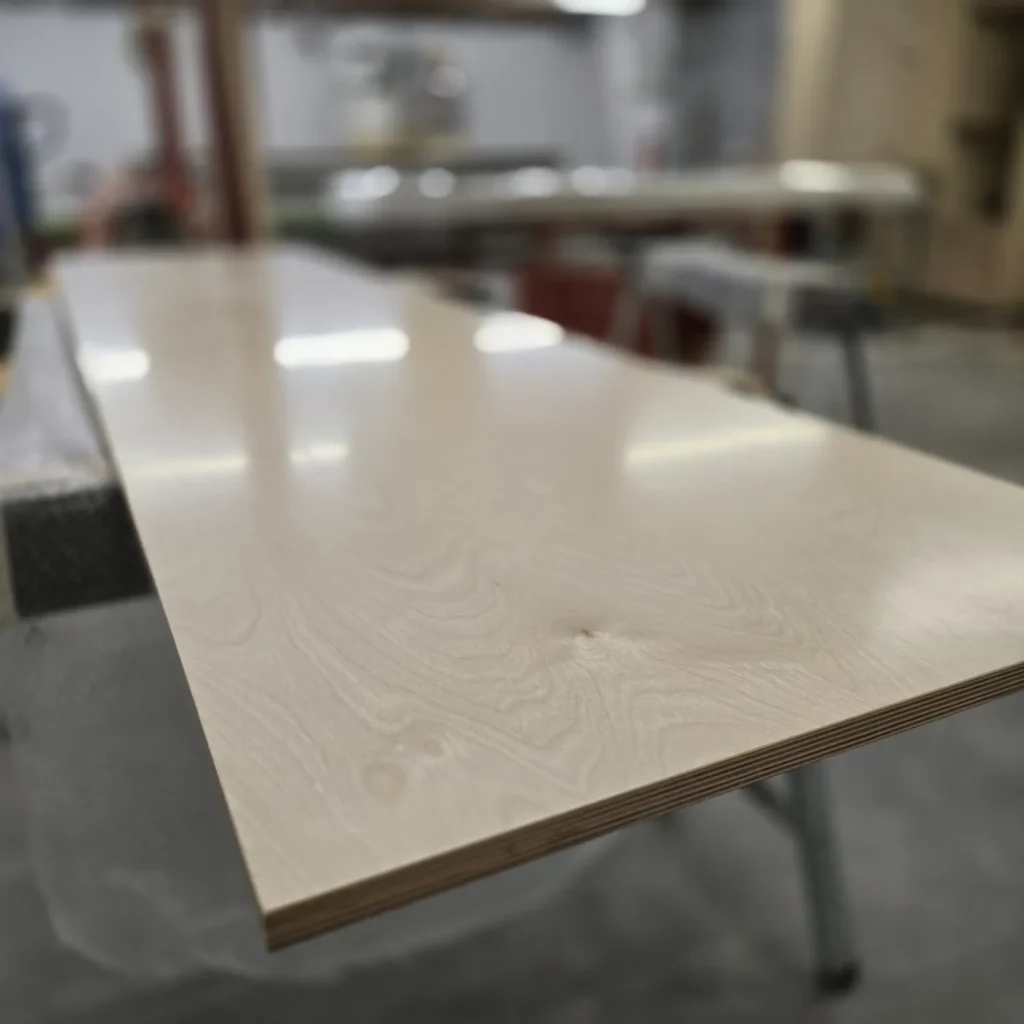
Choose the material for the component
Plywood: carcases, drawer boxes and visible edges
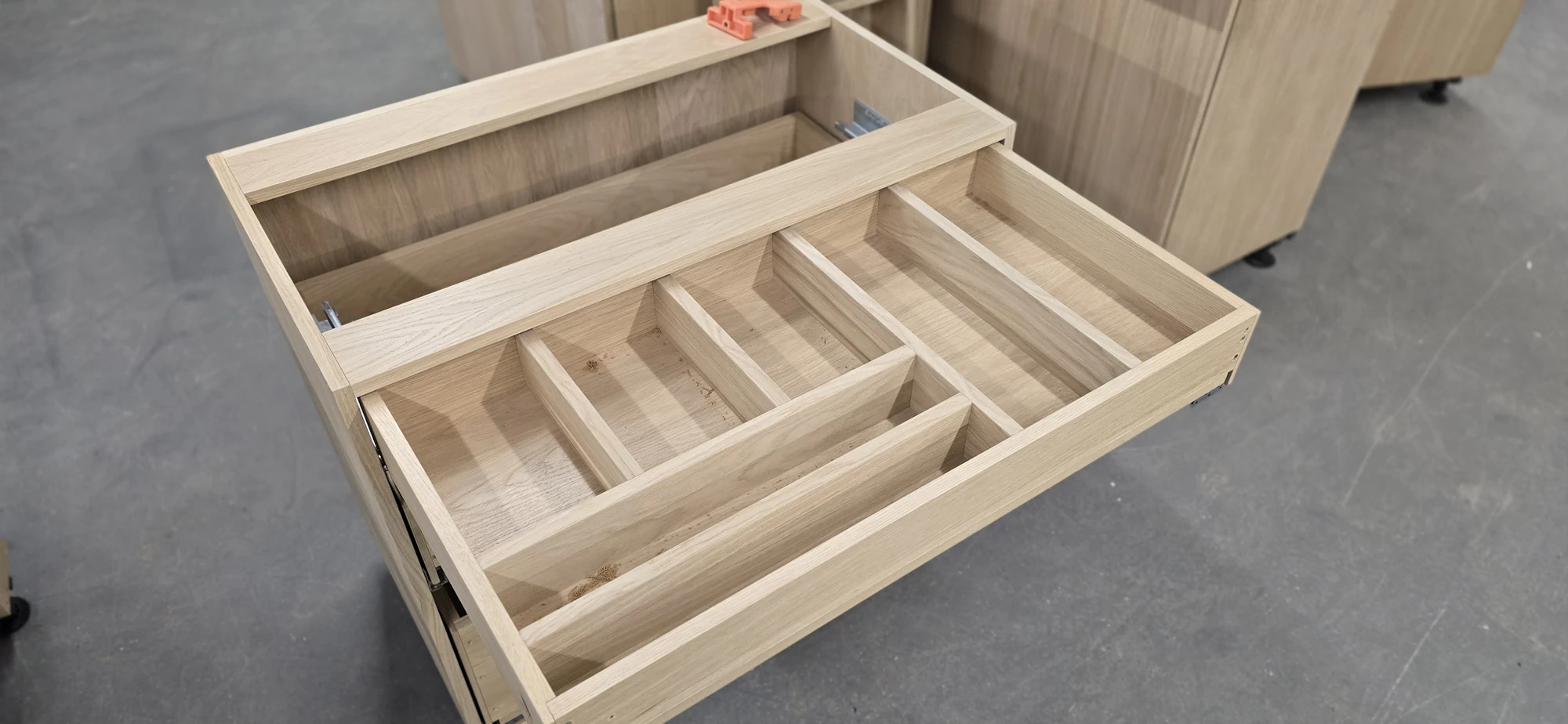
Plywood consists of bonded wood veneers, normally with alternating grain directions. High-quality birch plywood is useful for cabinet carcases, drawer boxes, shelving and components where stiffness and reliable fixing matter. Its layered edge can be deliberately exposed.
However, plywood is a category, not a quality standard. Timber species, face grade, internal veneers, bonding and manufacturing specification vary. For one documented example, WISA-Birch has its own product information and performance documentation. Those values should not be assumed for every plywood.
MDF: painted fronts and routed detailing
MDF is made from refined wood fibres and resin pressed into a consistent board. Its smooth surface suits painted furniture and detailed machining, including Shaker-style fronts. An appropriate MDF product may be a better choice for a painted door than plywood.
MDF can also provide a flat substrate for natural veneer. Specify the grade, finishing system and intended environment rather than treating all MDF as identical.
MFC: prefinished cabinet components
Melamine-faced chipboard combines a particleboard core with factory-applied decorative faces. It offers a wide range of colours and decors and can be processed efficiently. A suitable MFC specification can be entirely appropriate for internal components and projects where exposed plywood edges are not part of the brief.
For example, EGGER distinguishes furniture-grade P2 and moisture-resistant P3 options. The specific core, edging, fixings and furniture construction still matter.
What about cost?
Compare like-for-like specifications. The finished quotation includes machining, finishing, edging, hardware and installation as well as board costs. A saving on one component does not explain the value of the complete kitchen. Ask where different materials are used and what practical benefit each choice provides.
Durability, moisture and indoor air quality
Moisture-resistant does not mean waterproof
Specify boards for their intended conditions and protect exposed or cut edges. Pay particular attention to detailing around sinks, dishwashers and other moisture sources. Plywood performance depends on its type and bonding specification; MDF and particleboard are available in different grades.
MEDITE confirms that its MR MDF is intended for humid interiors but is not waterproof. That is a product-specific example, not a promise about every board labelled moisture-resistant.
What determines how long furniture lasts?
There is no reliable universal lifespan based only on the words plywood, MDF or MFC. Board quality and thickness, shelf design, joints, edge protection, the positioning of fixings, hinges and drawer systems, installation and everyday care all contribute.
Good plywood does not compensate for poor construction. Equally, correctly specified MDF or MFC can perform well in a suitable application. For shelves and fixings, ask how the component has been designed for its intended use rather than relying on a material ranking.
What about formaldehyde?
Adhesives or resins can be part of all three manufactured board categories. Emissions depend on the actual product and its manufacturing system; a material name alone does not establish its emissions performance.
Ask for the technical data and emission classification of the board being proposed. Where indoor air quality is part of your brief, include that requirement in the specification from the start. We do not assign a health or emissions ranking to these broad material categories.
What the finished kitchen can—and cannot—show
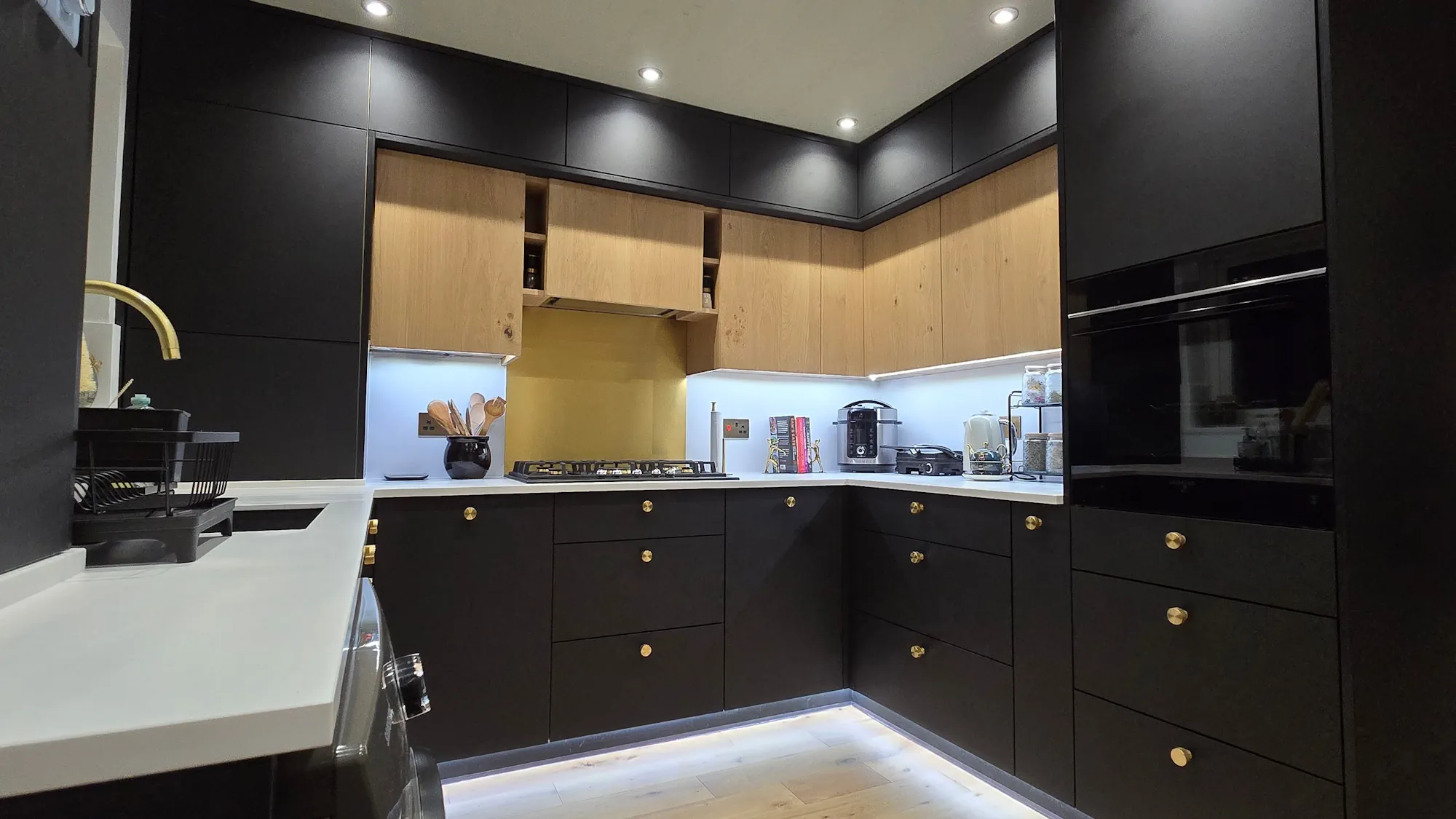
This finished kitchen illustrates why the specification matters: matt fronts, timber detailing and a premium worktop describe the appearance, but do not reveal every substrate or internal component. Two similar-looking kitchens can be built differently.
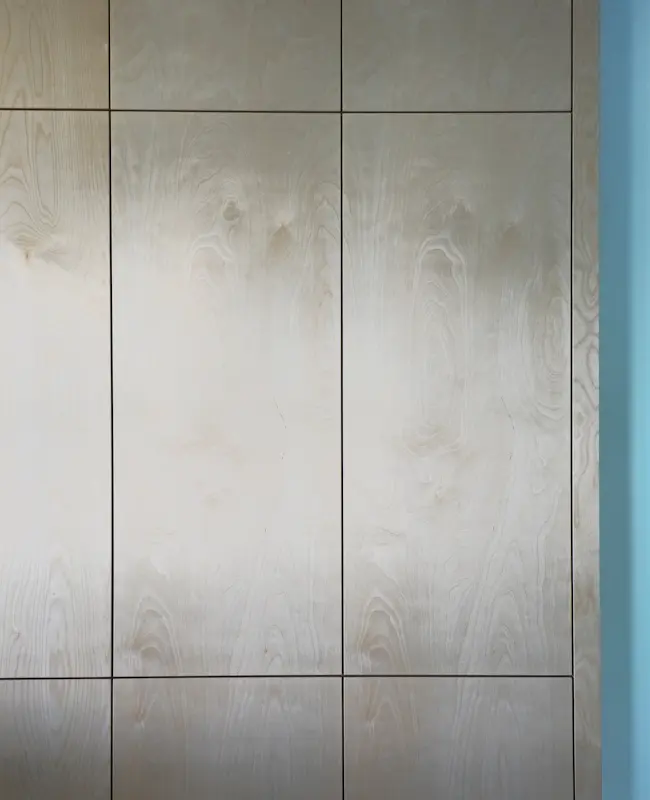
The same material can produce different results
Two makers can specify oak veneer yet deliver different visual outcomes. Selecting sheets and planning grain direction across adjacent doors, drawer fronts and tall units requires deliberate detailing.
Read how we approach grain-matched kitchens and wardrobes. The quality lies in how a material is selected and used, as well as its name.
What bespoke manufacturing changes
Dimensions, internal layouts, materials, finishes and hardware can follow the project instead of a predetermined cabinet system. This allows us to choose combinations deliberately: birch plywood with veneer, FENIX, decorative laminate, ceramic, solid timber or painted MDF, as appropriate.
Our guide to how genuinely bespoke furniture is designed and manufactured explains that wider process.
Questions to ask when comparing quotations
A supplier should be able to explain the construction behind the finished appearance. Use these questions to compare the complete specification:
- What are the cabinet carcases made from?
- What are the drawer boxes made from?
- What is the substrate underneath the door finish or veneer?
- What materials are used for shelves and cabinet backs?
- What thickness and grade of board is being specified?
- Are different materials being used around sinks or other moisture-sensitive areas?
- How are exposed and cut edges protected or finished?
- What hinges and drawer systems are included?
- Is grain matching included where natural timber or veneer is being used?
- Is the complete material specification clearly written into the quotation?
Ask for these details in writing. A price difference may reflect something you cannot identify from a rendering or showroom display. Compare the grade, detailing and included work before deciding which proposal offers better value.
Choose a specification for your project
At JS DECO, we frequently use high-quality birch plywood for cabinet carcases, drawer boxes and structural components because it suits our approach to manufacture. We also use other materials where they are appropriate. The aim is the right combination of function, durability and appearance for each component.
We design and manufacture bespoke kitchens and fitted furniture in Wakefield for residential and commercial projects across the UK. Projects can be supplied as cabinetry only or developed through to full installation.
The manufacturer links above explain particular products and grades. They are reference examples, not a statement that those exact products are supplied in every JS DECO project. Your quotation should identify your agreed specification.