
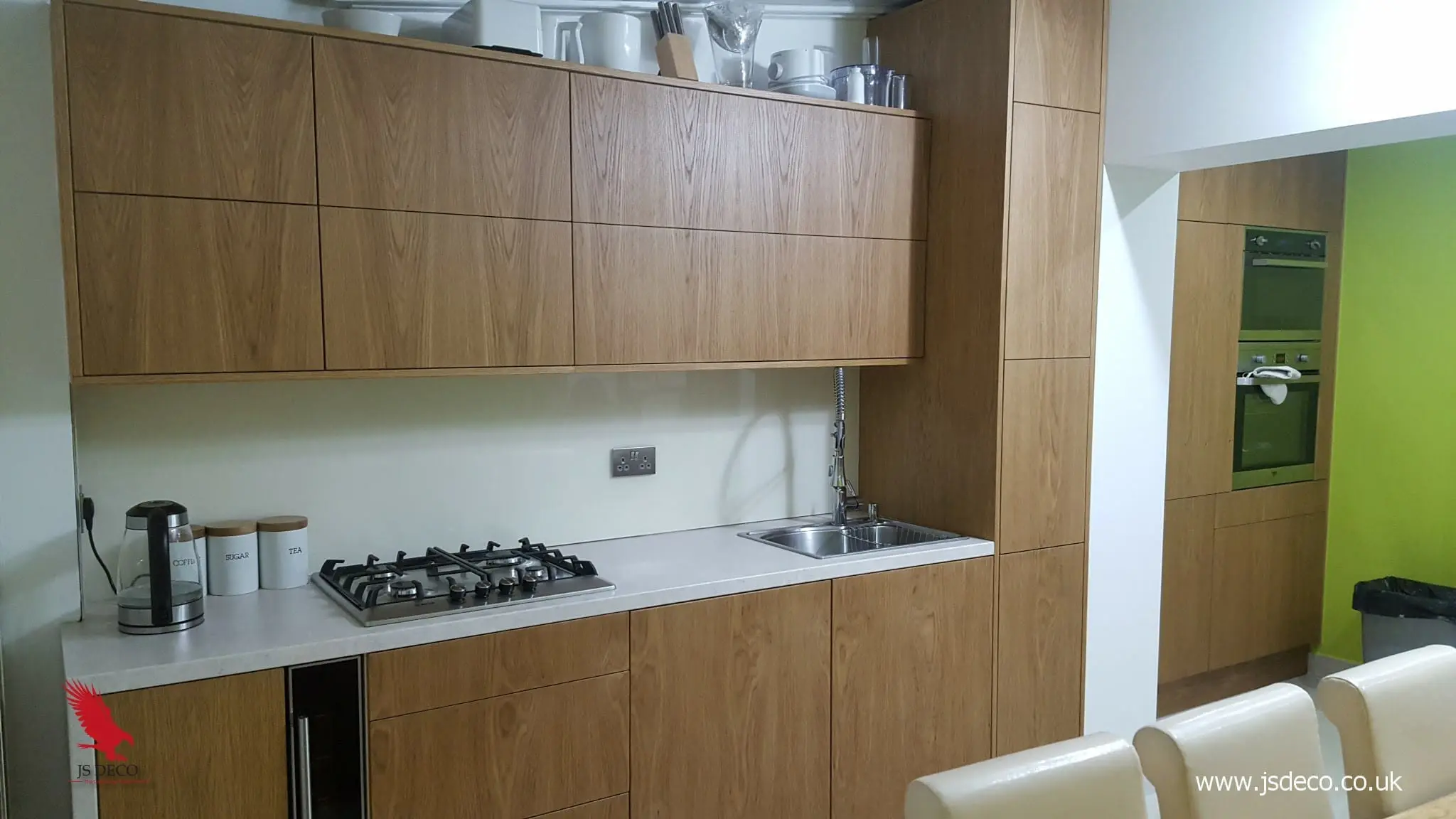
This Wakefield, West Yorkshire project was completed for a private home where a new extension had to be turned into a fully working kitchen. The brief was to create a clean modern kitchen with natural oak character, while also absorbing awkward practical elements into the furniture, including a niche containing the boiler and washing machine. The final result is a compact single wall kitchen with full height housing, handleless oak veneered fronts, and integrated appliances, all set out to suit the room geometry rather than forcing the room to suit standard unit sizes.
Project overview
The main challenge in this project was not only aesthetic. The extension had to work as a real kitchen, which meant the cabinetry needed to organise cooking, washing, storage, and built in appliances within one disciplined run. At the same time, the furniture had to cover a niche containing service elements that would otherwise have left the room looking unfinished.
The whole kitchen was made in our workshop, with the cabinets built around the actual conditions of the room. That room specific approach is exactly why fully bespoke manufacture differs from adapting factory modules, as explained in how bespoke furniture really works. In a project like this, the visual success comes from solving the awkward parts properly, not from adding decoration afterwards.
The result is a controlled modern composition with long horizontal lines, full height storage, and a warm oak veneered finish that softens the minimal handleless look. Instead of leaving service elements exposed, the kitchen turns them into part of one coherent piece of fitted furniture.
Project snapshot
Location: Wakefield, West Yorkshire
Property type: Private home with kitchen extension
Layout: Single wall run with full height appliance and service housing
Fronts: MDF with natural oak veneer, finished in satin varnish
Carcase: 18 mm laminated chipboard with PVC edging
Worktop: 44 mm laminate worktop
Hardware: Blum push to open bifold system on top units, Blum tip on soft close runners on base units
Key appliances: Integrated wine cooler, integrated dishwasher, gas hob, integrated oven, steam cooker
Notable constraint solved: Extension adapted into a kitchen, with the boiler and washing machine integrated into the overall run
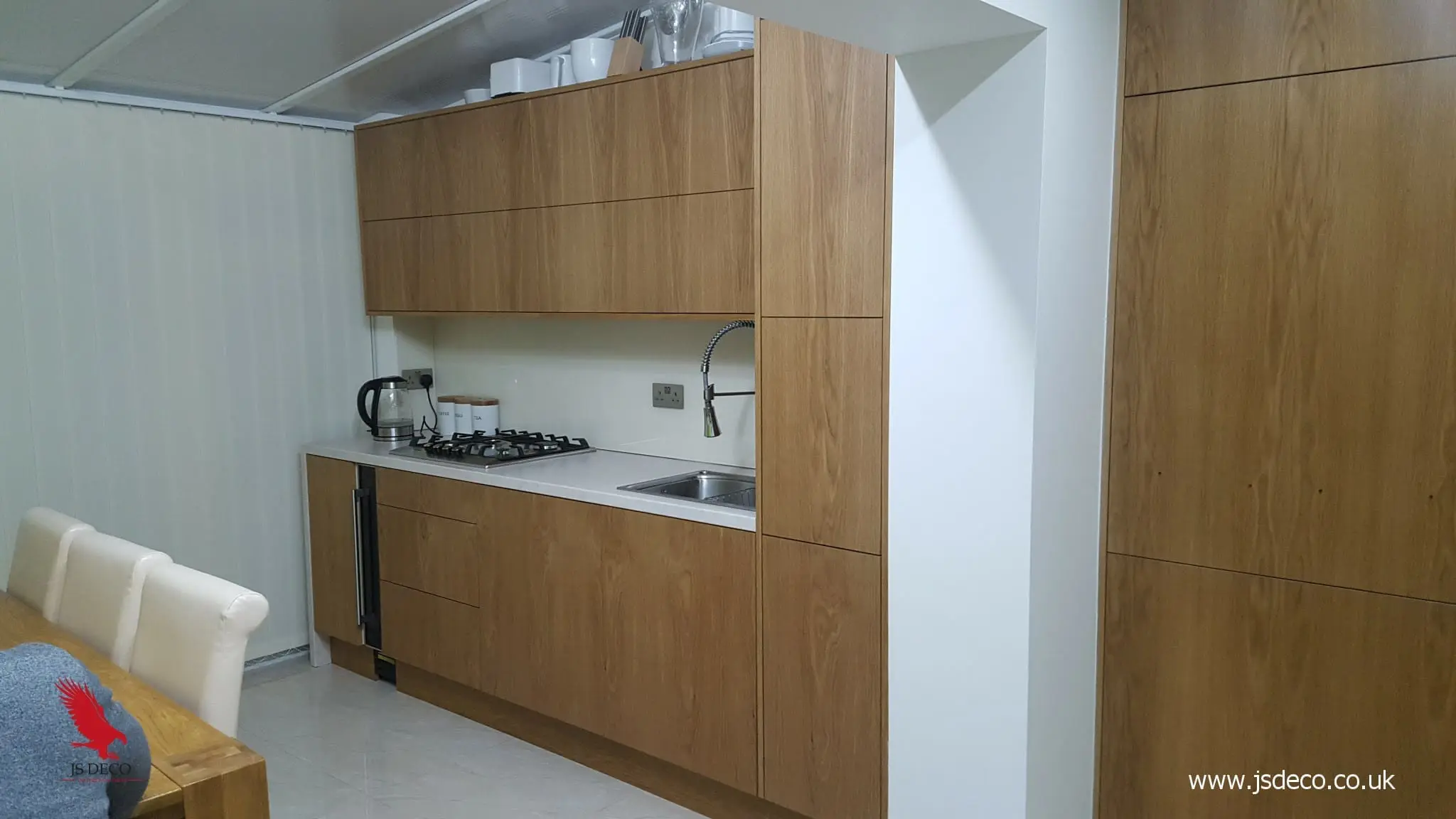
Design and planning
Because the extension had to be adopted as a kitchen, the planning stage had to resolve more than cabinet widths alone. The run needed to support a hob, sink, integrated appliances, upper storage, and tall housing without breaking the line of the room. The composition therefore relies on a clear linear arrangement, with base units, worktop, wall units, and full height cabinetry all aligned into one continuous elevation.
A key part of the planning was the treatment of the niche with the boiler and washing machine. Rather than leaving that area exposed or visually disconnected, it was absorbed into the fitted structure so the room reads as one complete installation. This is the kind of measured coordination where our dedicated kitchen design service becomes especially useful, because the goal is not only to fit furniture into a room but to make the technical and visual parts work together cleanly.
That logic is also visible in the tall housing section. The full height element gives the kitchen a stronger architectural edge, balances the lower run, and provides a natural place for built in stainless steel appliances without interrupting the oak veneered surfaces more than necessary.
Furniture specification
Cabinet engineering
The cabinet core is made from 18 mm laminated chipboard finished with PVC edging, which provides a practical and stable internal construction. All visible external elements are made from MDF covered in natural oak veneer and finished in a satin varnish. That combination allowed the kitchen to keep a crisp contemporary form while introducing a real wood surface with a warmer and more individual character.
An important detail in this project is the way the veneered components were prepared to match the grain pattern across the visible fronts. This takes more time and care than standard production because the fronts must be selected and cut with continuity in mind. The benefit is that the finished kitchen reads as a complete fitted composition rather than a row of unrelated doors and panels.
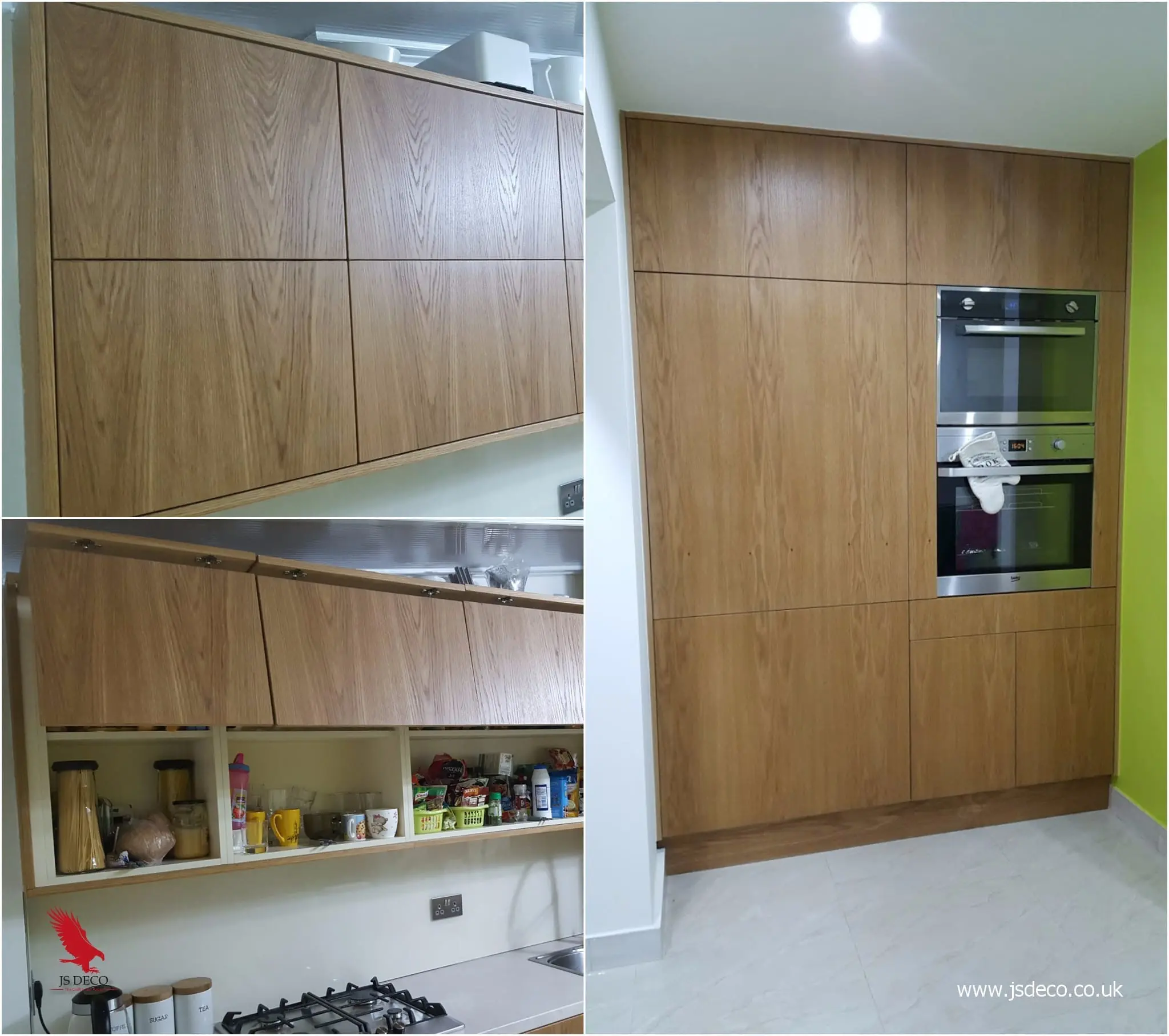
The upper cupboards use Blum push to open bifold doors, while the base units use the Blum tip on and soft close runner system. Together these details support the handleless look without making the kitchen feel mechanically awkward in daily use.
Appliance integration
The specification includes an integrated wine cooler, integrated dishwasher, gas hob, integrated oven, and steam cooker, all in brushed stainless steel finish. These elements were incorporated into the furniture so the practical working parts of the kitchen remained visually disciplined rather than dominating the room.
The stainless steel sink and tap keep the wash area simple and durable, while the glass splashback gives the cooking zone a clean finish that works comfortably with the laminate worktop and the oak veneered cabinetry. The overall effect is modern, but not cold, because the material palette balances steel and glass with the natural depth of oak.
Smart storage and daily use
This kitchen shows how a relatively compact run can still work efficiently when every section has a clear role. The upper bifold cupboards provide storage without relying on conventional side hung doors that project further into the room when open. In everyday use, that makes them practical for cups, dry goods, and other regularly used items while keeping the front visually flat when closed.
At base level, the mix of drawers and cupboards allows the main working zone to support food preparation, cooking, and clearing down within one linear sequence. The hob, sink, and work surface are kept close enough to function together, while the integrated dishwasher keeps the washing area within the same controlled stretch of furniture rather than separating it elsewhere in the room.
The tall section also improves daily use in two ways. First, it provides a disciplined location for the oven and steam cooker at a more practical access height. Second, it helps absorb service related elements into the fitted kitchen so the room feels ordered and resolved in normal day to day use, not only in photographs.
Materials and finishes
Natural oak veneer was an important choice in this project because the room needed warmth as well as precision. A fully flat handleless kitchen can easily become too hard or too plain if the surfaces do not bring enough depth. Here, the oak veneer introduces a clear grain pattern and a more natural visual rhythm, while the satin varnish keeps the surface controlled rather than overly glossy.
Compared with solid wood doors, a veneered front gives the customer the real appearance of oak while using less timber overall. That matches the original thinking behind the project, where the aim was to combine the visual quality of wood with a more measured use of material. Because the grain was aligned carefully across the fronts, the finish does not just decorate the cabinets, it helps define the identity of the whole room.
The 44 mm laminate worktop adds a robust and straightforward working surface that suits a modern kitchen used every day. Together with the glass splashback and stainless steel fittings, it gives the project a practical working layer underneath the more refined veneered finish.
Before and after analysis
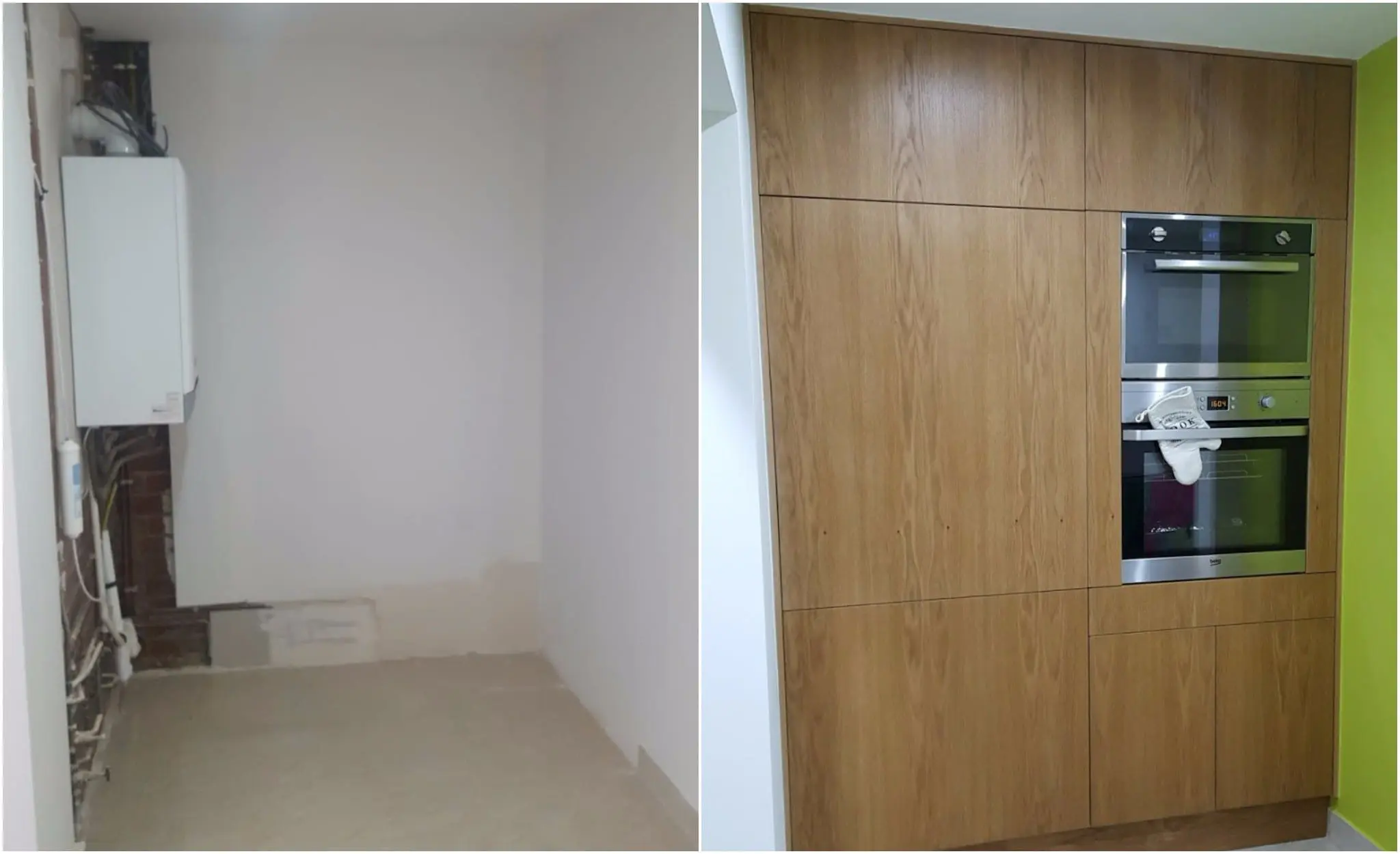
Before the installation, the extension was simply an empty area with exposed service elements and no integrated kitchen structure. The boiler niche in particular would have remained visually awkward if it had been treated as a separate practical problem rather than part of the furniture design.
After manufacture and fitting, that same area became a complete kitchen wall with continuous worktop, concealed technical zones, integrated appliances, and full height storage. The change is practical as much as visual. Instead of a plain extension waiting to be adapted, the room now has a clear cooking and washing zone, better organised surface area, and a much stronger sense of order.
The most successful part of the transformation is that the problem areas do not look like problem areas anymore. The extension reads as a finished kitchen space because the cabinetry was set out to suit the room constraints from the start.
Final result
This Wakefield project is a good example of what a bespoke kitchen can achieve when the room has to do more than accept standard units. The extension, the service niche, the tall appliance bank, and the material specification were all resolved as part of one joined up design and manufacturing process. That is why the finished kitchen feels composed rather than improvised.
Visually, the kitchen stays modern and restrained, but the natural oak veneer keeps it from becoming sterile. Functionally, it provides a complete working arrangement with integrated appliances, push to open storage, and furniture made specifically for the available space. For customers looking at this style of hand made bespoke kitchen furniture, this project shows the value of building around the room rather than trimming expectations to fit factory limitations.
Starting a similar project
Projects like this usually start with an initial discussion about the room, the preferred material direction, the appliances to be integrated, and any awkward areas that need to be absorbed into the design. From there, the process moves through measured planning, design sign off, manufacture in our workshop, and then delivery or installation depending on the scope. The practical steps are outlined in more detail on how to start your project with us.
