
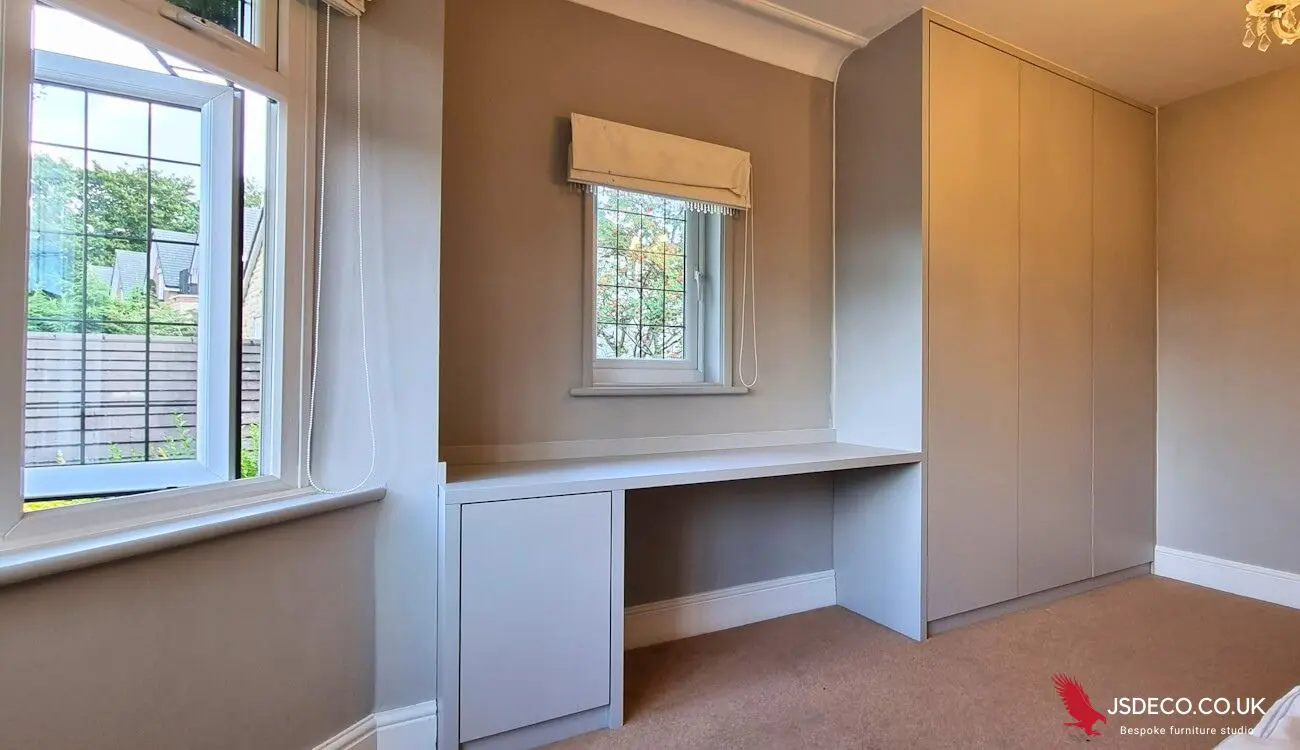
This Leeds, West Yorkshire bedroom furniture project focused on creating a calm modern arrangement with clean proportions, discreet storage and a genuinely handle less appearance. The set combines fitted wardrobes with a matching dressing table, all manufactured as a room specific solution rather than assembled from standard modules. Grey Egger matt MFC board was selected for the visible surfaces, while Blum mechanical components were used to support reliable day to day movement and long term durability. The main challenge was to keep the furniture visually light and contemporary while still delivering practical storage and a coherent relationship between wardrobes and dressing area. This is the type of room specific work that sits naturally within our bespoke wardrobes and bedrooms service.
Spec snapshot
Location: Leeds, West Yorkshire
Layout: Wardrobe run with coordinated dressing table
Fronts: Grey truly handle less fronts in Egger matt MFC
Carcase:Egger MFC 18mm
Worktop: Egger MFC 36mm
Hardware: Blum mechanical components (25 years warranty)
Notable engineering detail: A continuous flush, handle less look across wardrobes and dressing area, set to suit the room constraints
Project overview
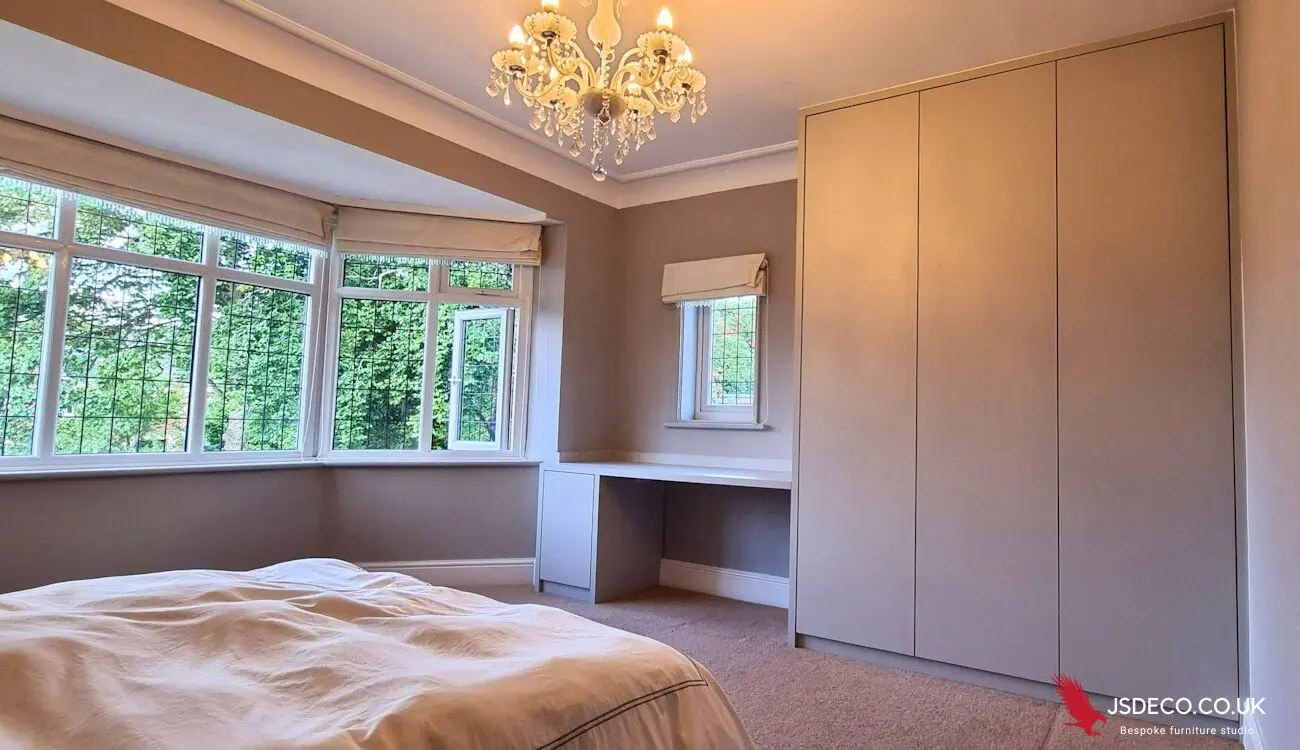
The design objective in this Leeds bedroom was not only to provide storage, but to control visual weight. Standard freestanding furniture often leaves gaps above, beside or between units, which creates dust traps and weakens the overall composition. Here, the decision was to treat wardrobes and dressing table as one coordinated set so the room reads as a complete fitted arrangement.
From an engineering perspective, the important move was to keep the elevations calm and uninterrupted. The truly handle less front treatment removes projecting hardware, which makes circulation around the room easier and keeps the lines cleaner. Exact dimensions were measured on site and confirmed during survey. Where fillers, scribes or height adjustments were required, they were set to suit the room constraints rather than forced into fixed modular sizes. The result is a fitted bedroom arrangement with stronger proportion control, better use of wall width and a more deliberate relationship between storage and dressing functions.
Design and planning
For fitted bedroom work like this, planning is mainly about alignment, access and internal zoning. We first verify wall lengths, ceiling condition and the usable depth that can be taken without making the room feel compressed. This is particularly important when a wardrobe run sits close to circulation routes or adjacent furniture.
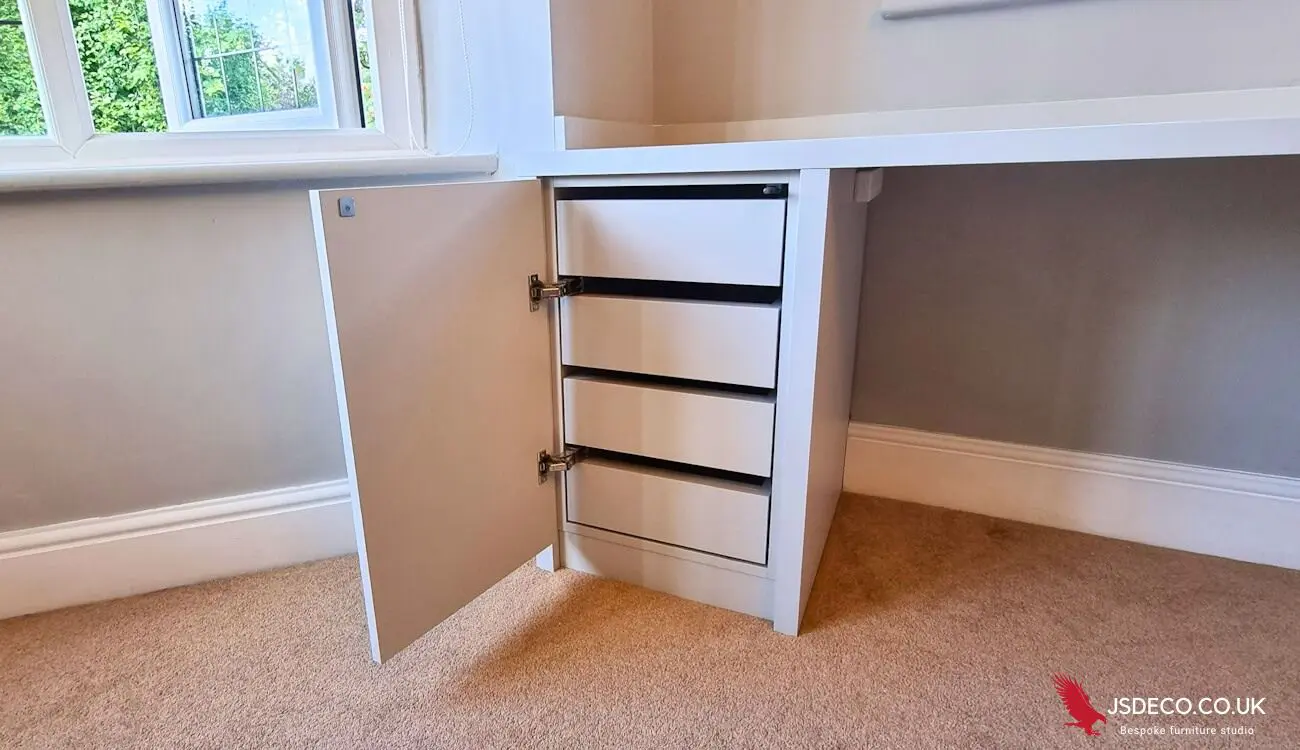
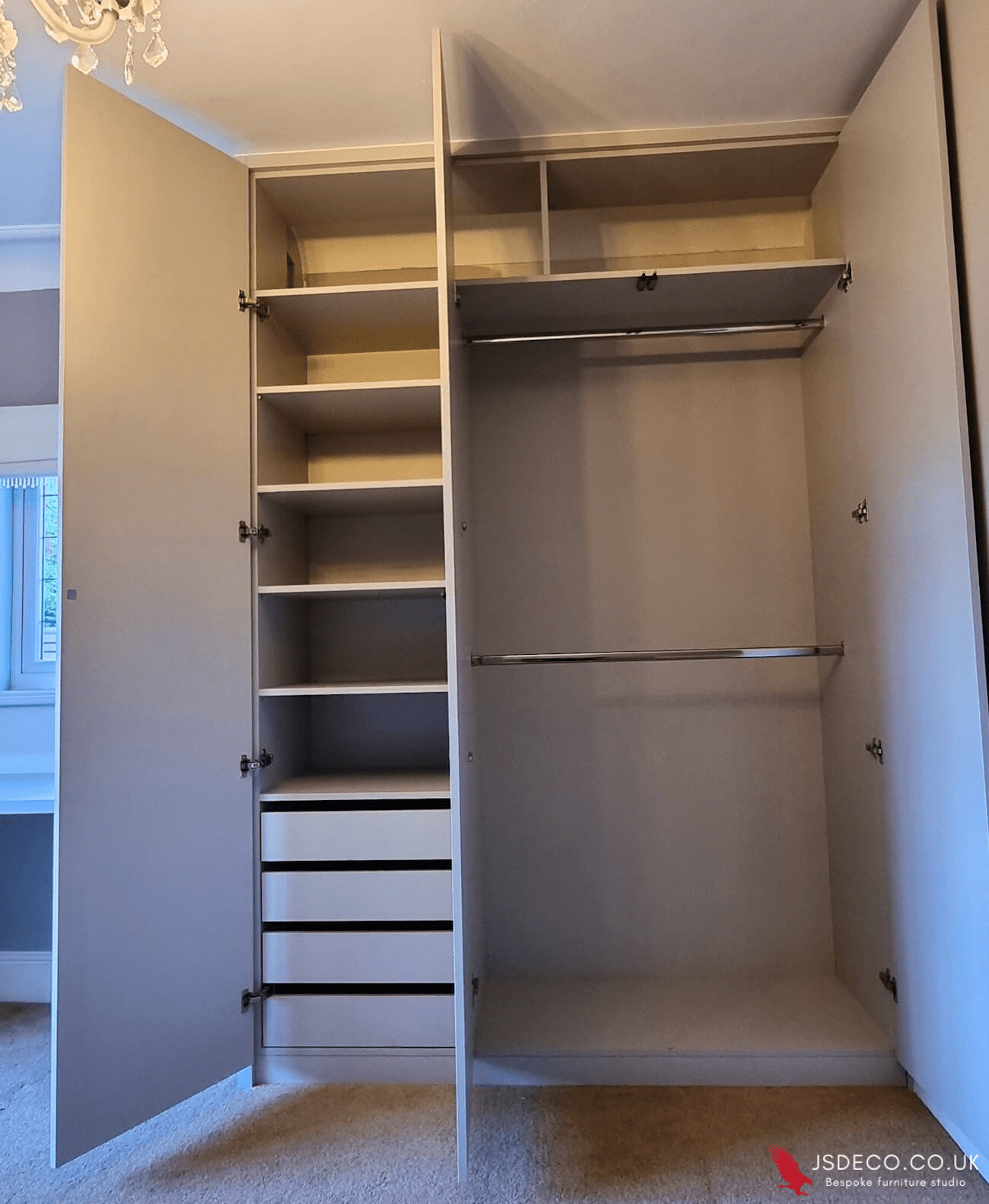
The second stage is organising use. Hanging storage, folded storage and dressing activity should not compete with each other. In this case, the dressing table works as a visual break in the larger composition while still staying within the same material language and front style. That is the practical difference between fitted furniture and adapted modular furniture, which we explain in more detail on our page about how bespoke furniture really works.
Furniture specification
Cabinet engineering
The visible finish for this bedroom set is Egger matt MFC board in grey, chosen for its controlled texture, low reflectivity and suitability for contemporary interiors. In a wardrobe setting this type of finish works well because it keeps large front surfaces visually calm and is easy to maintain in everyday use. The truly handle less look depends on accurate front alignment, consistent spacing and disciplined proportioning, because there is no decorative hardware to distract from poor geometry.
Blum mechanical components support the functional side of the build. Their role is not only movement, but also consistency over time. Repeated opening cycles matter in bedrooms because wardrobes are used every day, often multiple times a day. Exact board thickness and internal construction method were not specified in the original brief, but the overall set was manufactured as made to measure furniture rather than selected from preset sizes.
Storage logic and dressing integration
A bedroom set like this needs to solve two different tasks. The wardrobe section handles bulk storage and longer term organisation, while the dressing table supports daily routines and quick access items. Combining both in one coordinated composition reduces visual fragmentation and avoids the common problem of freestanding pieces looking unrelated to each other.
In practical use, one zone can be dedicated to hanging garments and larger items, while a second zone can support folded clothes, accessories or more frequently used pieces. The dressing table then becomes the short stay surface for personal items, mirror use or daily preparation. Because everything belongs to the same furniture language, the room feels more ordered and easier to maintain. For a broader view of our room specific manufacturing approach, see about JS DECO.
Before and after analysis
The main improvement in this Leeds project comes from consolidation. Instead of relying on separate furniture pieces with inconsistent proportions, the room gains a more unified storage wall and a dressing area that belongs to the same composition. That reduces visual breaks, makes better use of wall width and limits the kind of unused side gaps that appear around standard furniture.
The grey matt finish also changes the way the room reads. Because it reflects light softly rather than sharply, the larger furniture faces remain controlled and do not dominate the bedroom. Combined with the handle less detailing, the result is a cleaner elevation and a simpler day to day environment. The engineering value is not decorative complexity, but the fact that the furniture was set out specifically for this room and this use pattern.
Final results and how to start
This bedroom set shows how fitted wardrobes and a matching dressing area can be resolved as one architectural element rather than a collection of separate products. In Leeds, West Yorkshire, that approach allowed the room to stay visually simple while still delivering practical storage and dependable daily use through Egger matt MFC surfaces and Blum mechanical components.
The route into a similar project is straightforward. First, we discuss the room, your priorities and the type of storage you actually need. Second, measurements are confirmed on site. Third, the design and specification are signed off. Fourth, the furniture is manufactured to the agreed brief. Fifth, the project moves to delivery or delivery with installation, depending on scope. You can read more about the process on how to start your project with us. We cover Leeds and the wider UK, with lead times depending on current workload.