
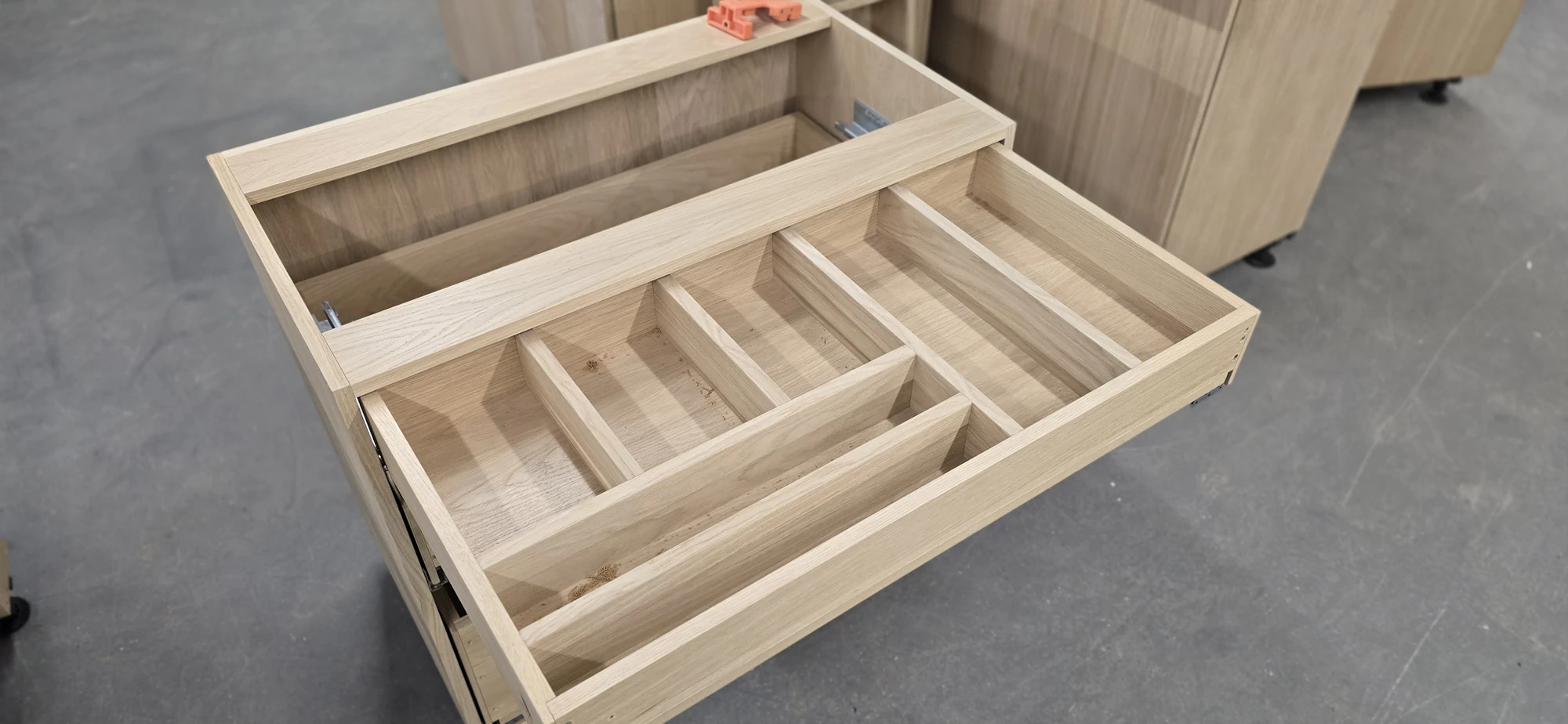
“Bespoke” is one of the most overused words in the kitchen and furniture industry. It is often applied to products that are still based on fixed factory systems, with only minor cosmetic adjustments.
On this page, we explain in practical terms what fully bespoke manufacturing actually means, how it differs from modular production, and who this approach is genuinely suited to. We outline the structural standards, design process and level of involvement required, so you can make an informed decision before committing to any project.
This is not a sales page. It is a transparent explanation of how we work, what you can expect, and where fully bespoke manufacturing sits within the wider market.
If you would like to understand the background of our workshop, experience and long-term approach to furniture making, you can read more About JS DECO.
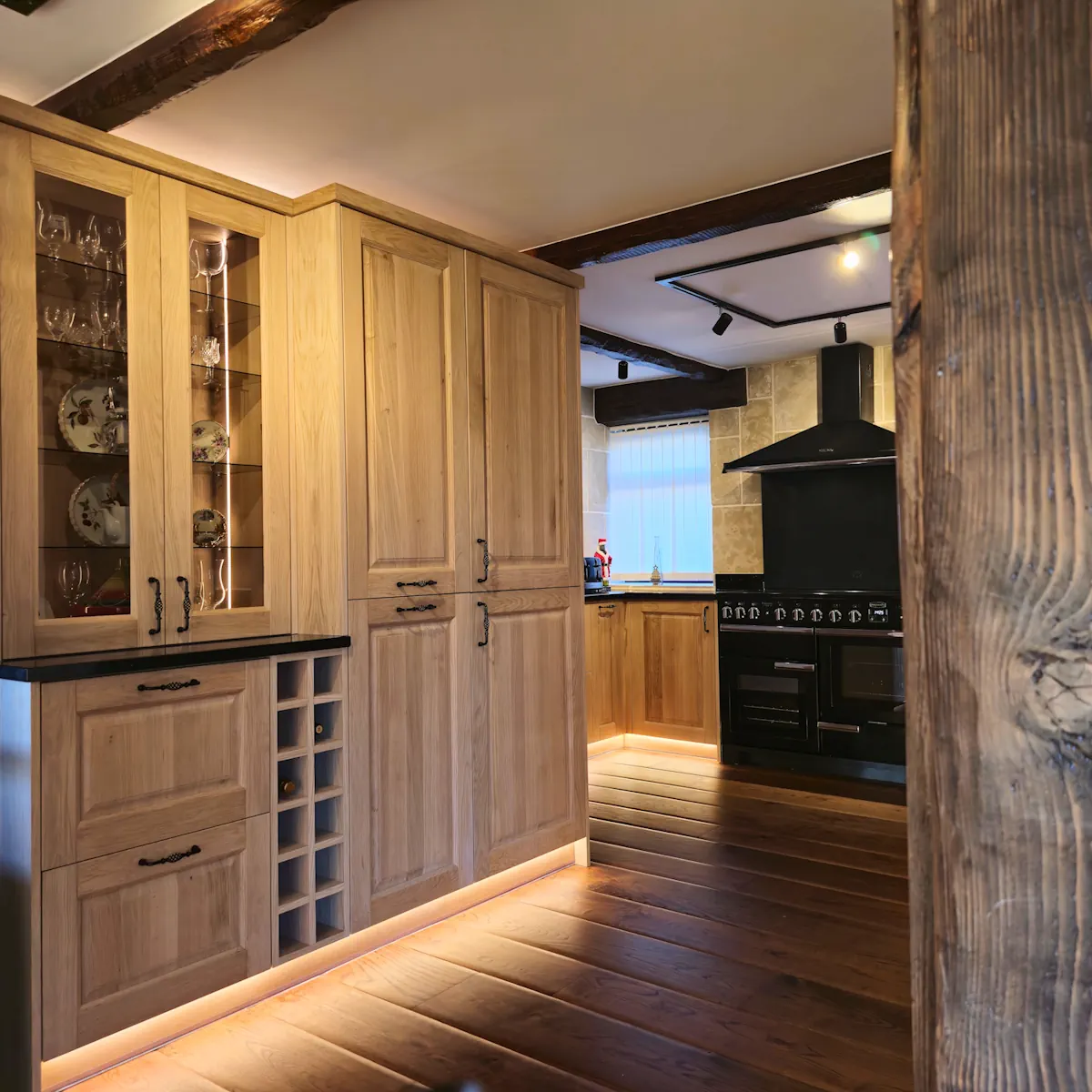
What “fully bespoke” actually means
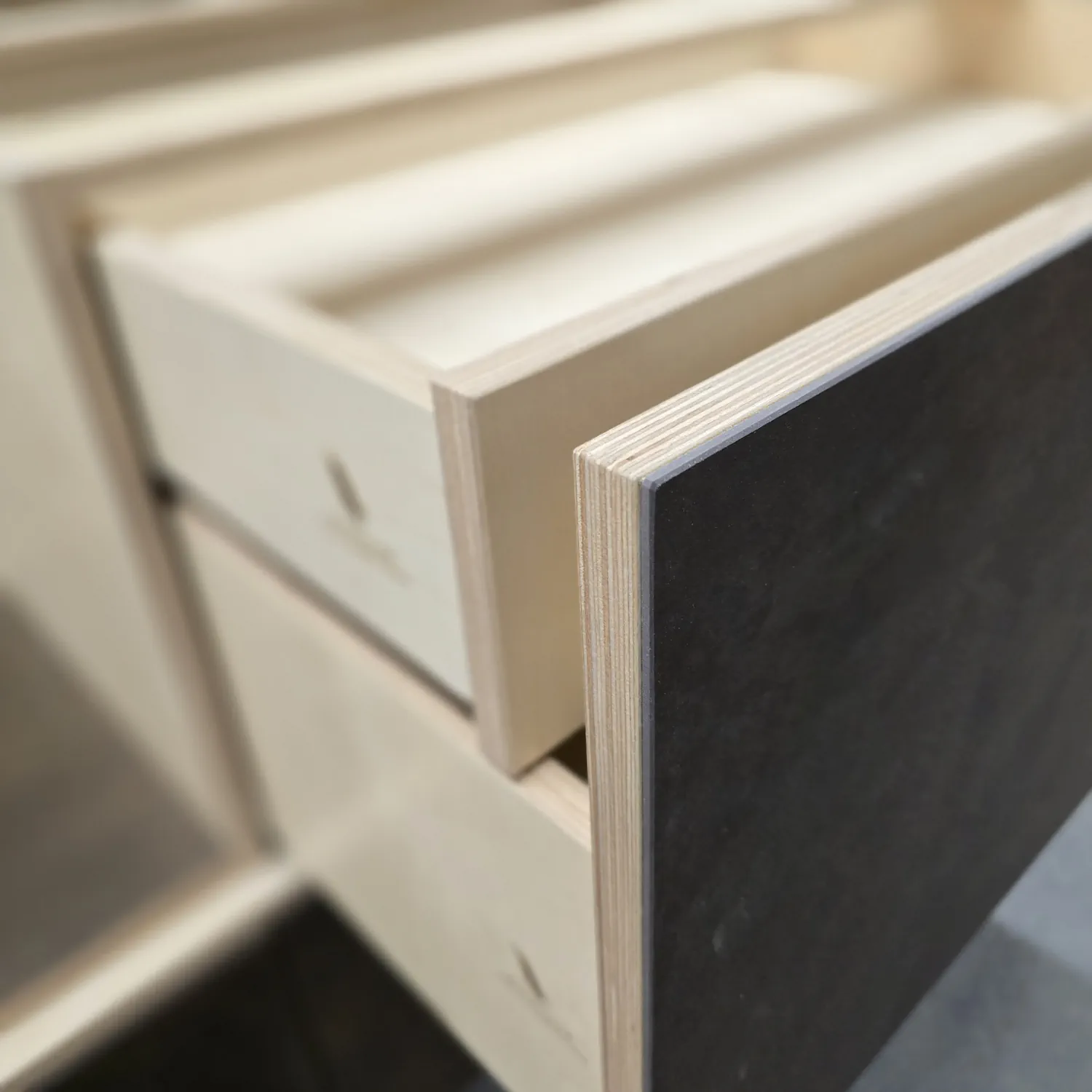
Fully bespoke furniture is not a modified catalogue product. It is not based on fixed cabinet sizes. It is not a factory system with optional upgrades.
Every cabinet is designed and manufactured from scratch to suit a specific space, layout, material specification, and set of priorities.
In practical terms, this means:
- No fixed cabinet width increments
- No imposed plinth heights
- No mandatory service void dimensions
- No standard internal layouts
- Materials selected intentionally, not by default
The design develops around the space. The space does not adapt to a system.
If you want to see how this translates into finished projects, explore our
Luxury Hand-Made Bespoke Kitchen Furniture page.
How It Differs From Factory or “Semi-Bespoke” Kitchens
Many kitchens described as bespoke are still based on modular factory carcasses.
| Feature | Fully Bespoke | Factory Modular |
|---|---|---|
| Cabinet Sizes | ⇒ Unlimited, made to exact dimensions and optimised to maximum capacity. Minimum plinth and void in favour of the actual carcass. | ⇒ Fixed increments (e.g., 300 / 400 / 500 / 600mm) |
| Carcass Thickness | ⇒ Typically 18mm birch plywood, 18mm solid wood, 19mm wood veneered MDF | ⇒ Often 15–16mm MFC |
| Back Panels | ⇒ Full 18mm structural backs matching the whole carcase material | ⇒ 6mm–8mm thin panels |
| Internal Finish | ⇒ Material-selected (plywood, veneer, colour matched) finished with high-quality lacquer providing moisture resistance | ⇒ Standard limited choice of melamine chipboard |
| Installation Fit | ⇒ Precision scribed to walls max 50mm fillers designed and manufactured with the shape and size of the space in mind | ⇒ Filler panels to absorb gaps often over 100mm. Cabinets made to be universal, not dedicated |
Fully bespoke manufacturing is not the most cost-driven approach. It is the most control-driven approach.
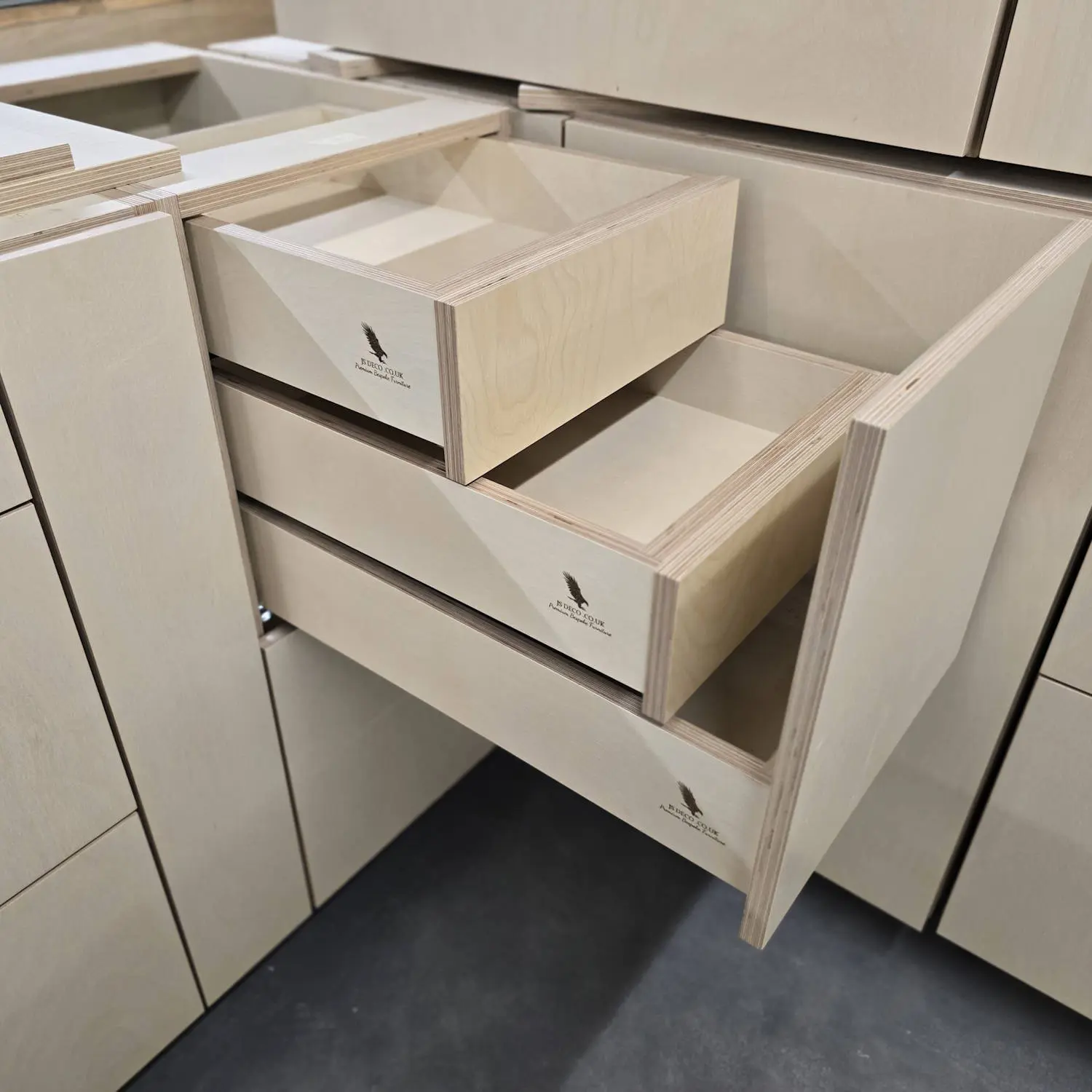
Materials & Structural Standards: Why They Matter
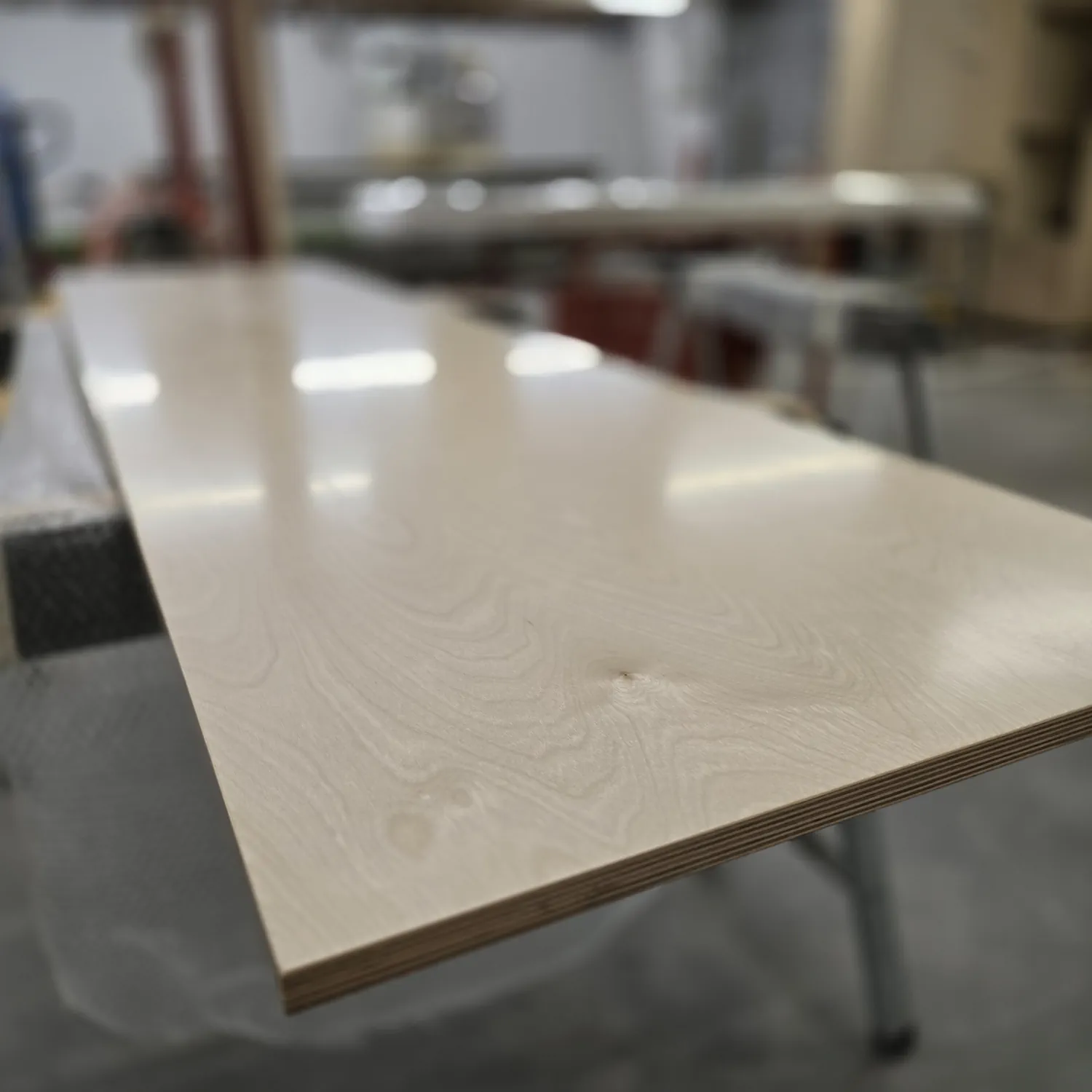
Construction quality determines durability, rigidity, and long-term stability.
As a structural baseline, we typically use:
- 18mm birch plywood carcasses
- 18mm full backs (not thin hardboard)
- Fully rigid assembled construction
- Blum soft-close hinges and drawer systems (25-year warranty)
- Spray-applied professional finishes
From this baseline, material specification can evolve depending on budget and architectural direction. Examples include:
- Oak veneered plywood
- Walnut veneered plywood
- FENIX NTM laminate finishes
- Solid hardwood detailing
- Colour-matched internal finishes
You can explore our plywood-focused construction approach here:
Plywood Core Kitchen Furniture.
Design Is a Process, Not a Drawing
In fully bespoke manufacturing, design is iterative. It evolves through discussion, refinement, and technical validation.
We do not begin production based on concept visuals alone. The process includes:
- Dimensional verification
- Technical detailing
- Appliance integration planning
- Internal configuration review
- Material sample confirmation
For clients who require structured planning support, our
Dedicated Kitchen Design Service explains the process in detail.
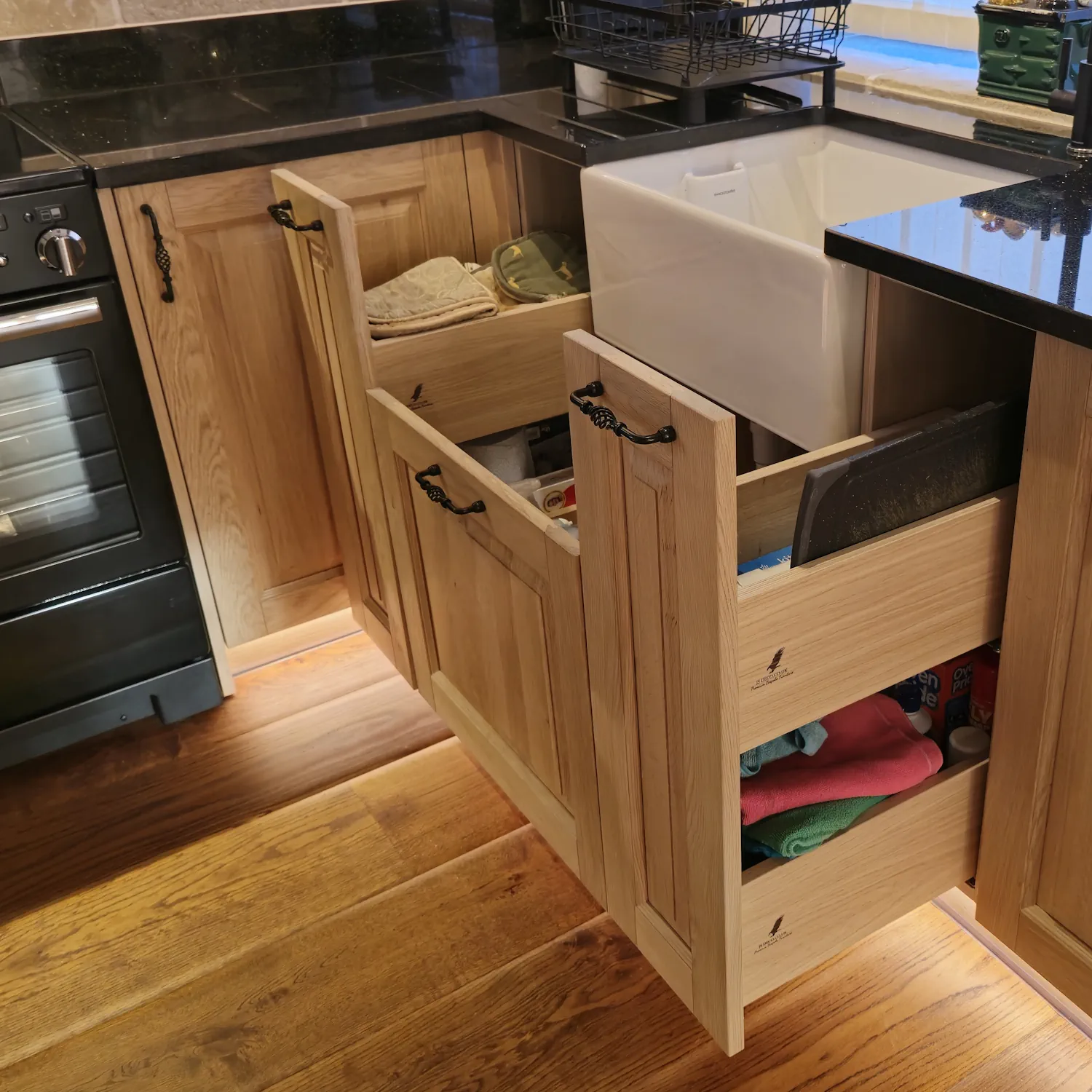
Budget Expectations & Transparency
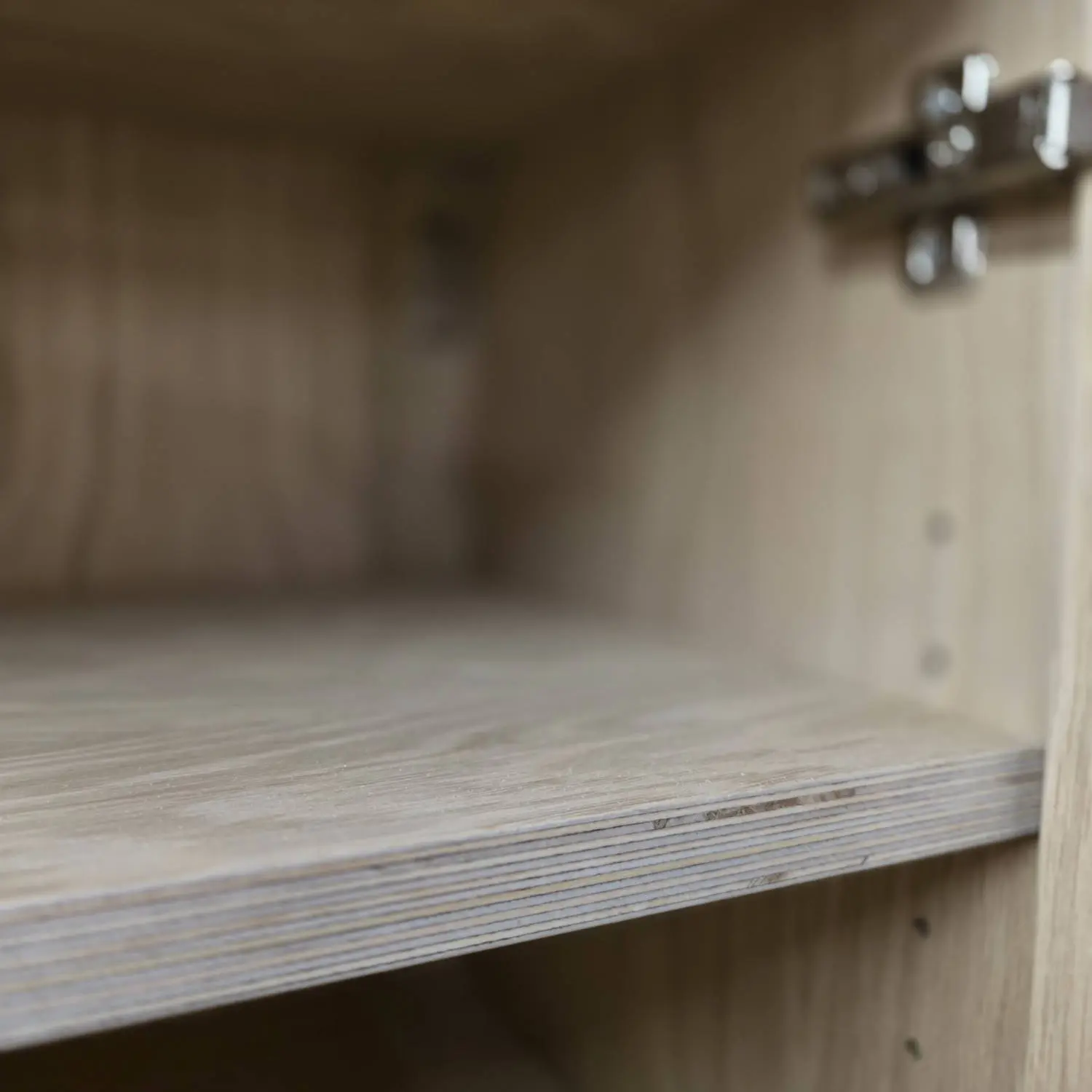
Fully bespoke furniture involves individual design development, workshop manufacturing, and controlled installation.
Costs reflect:
- Material selection
- Construction method
- Design complexity
- Project management time
- Installation logistics
We are transparent about investment ranges early in discussion. If a project needs to remain within strict modular-level budgets, a factory system may be more appropriate.
Common Misconceptions About Bespoke Kitchens
The word “bespoke” is frequently used in the kitchen industry, but it is often misunderstood. Many assumptions are based on surface appearance rather than structural reality. Below are some of the most common misconceptions — and what actually differentiates true bespoke manufacturing.
- “Bespoke just means painted doors.”
In reality, fully bespoke manufacturing affects the entire internal structure of the kitchen — not only the visible front. Cabinet dimensions, carcass thickness, internal layout, service void positioning and structural reinforcement are all individually engineered. The doors are only the outer expression of a deeper construction decision. - “All bespoke is automatically overpriced.”
Price is determined by material specification, detailing complexity and manufacturing method — not by the label. A rigid, 18mm birch plywood carcass, precision-machined joinery and long-term structural stability cannot be compared directly to mass-produced flat-pack systems. The value lies in engineering accuracy, longevity and adaptability over time. - “Factory kitchens are always better value.”
Factory kitchens are optimised for production efficiency and fixed modular sizing. Bespoke kitchens are optimised for spatial precision and architectural proportion. While factory systems may appear lower in initial cost, thinner materials, fixed cabinet heights and limited structural flexibility can impact lifespan and future modification potential.
True bespoke cabinetry removes catalogue constraints. There are no fixed cabinet widths, imposed plinth heights or predetermined internal layouts. Every element is manufactured specifically for the space and the client’s priorities — whether that means maximising storage, aligning with complex architectural lines or integrating appliances seamlessly.
At JS DECO, we manufacture using 18mm birch plywood carcasses, rigid assembled construction and precision CNC machining. This allows us to control structural integrity, internal usability and visual proportion without compromise.
Bespoke is not about decoration. It is about engineering, proportion and long-term performance.
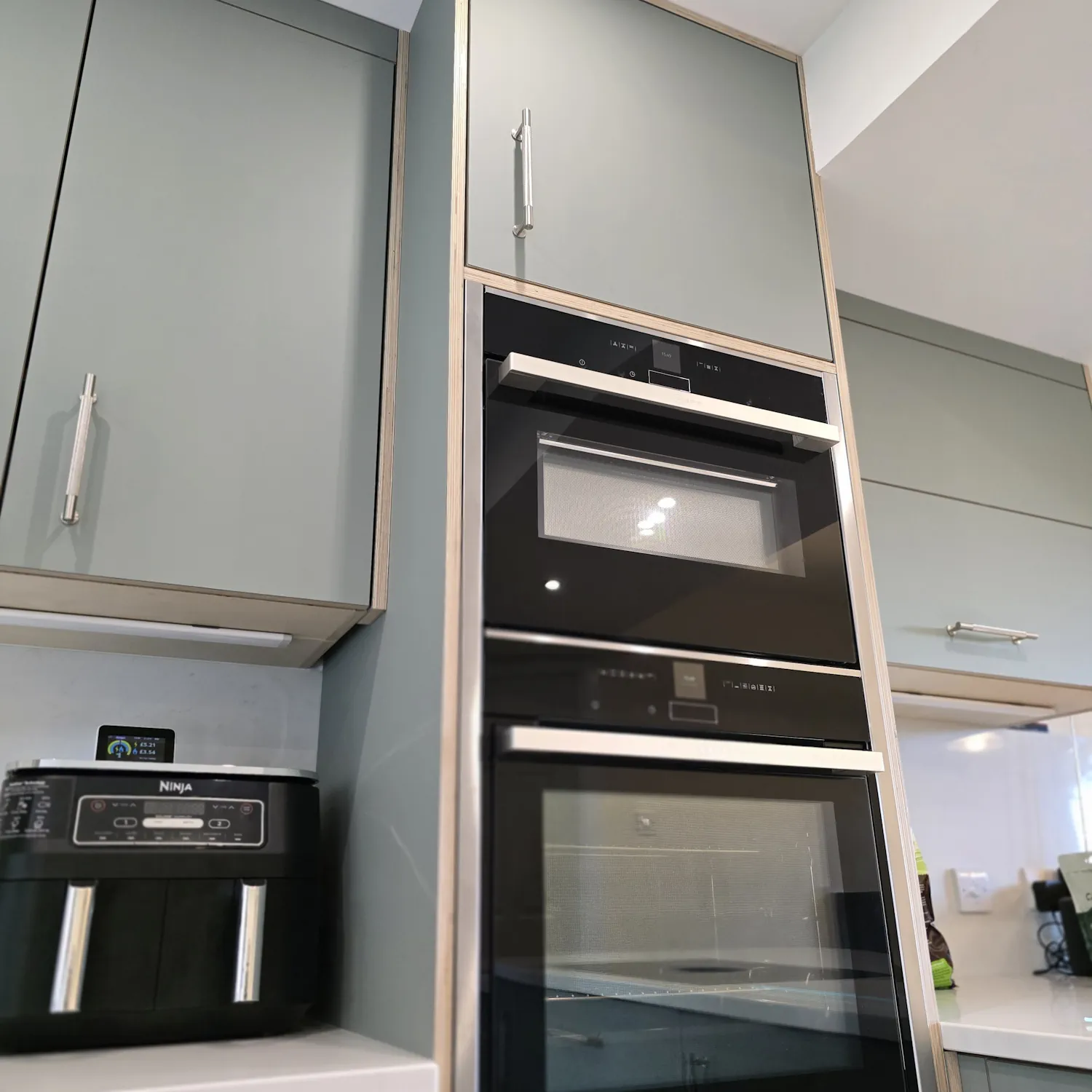
Grain matching for clear finished veneers
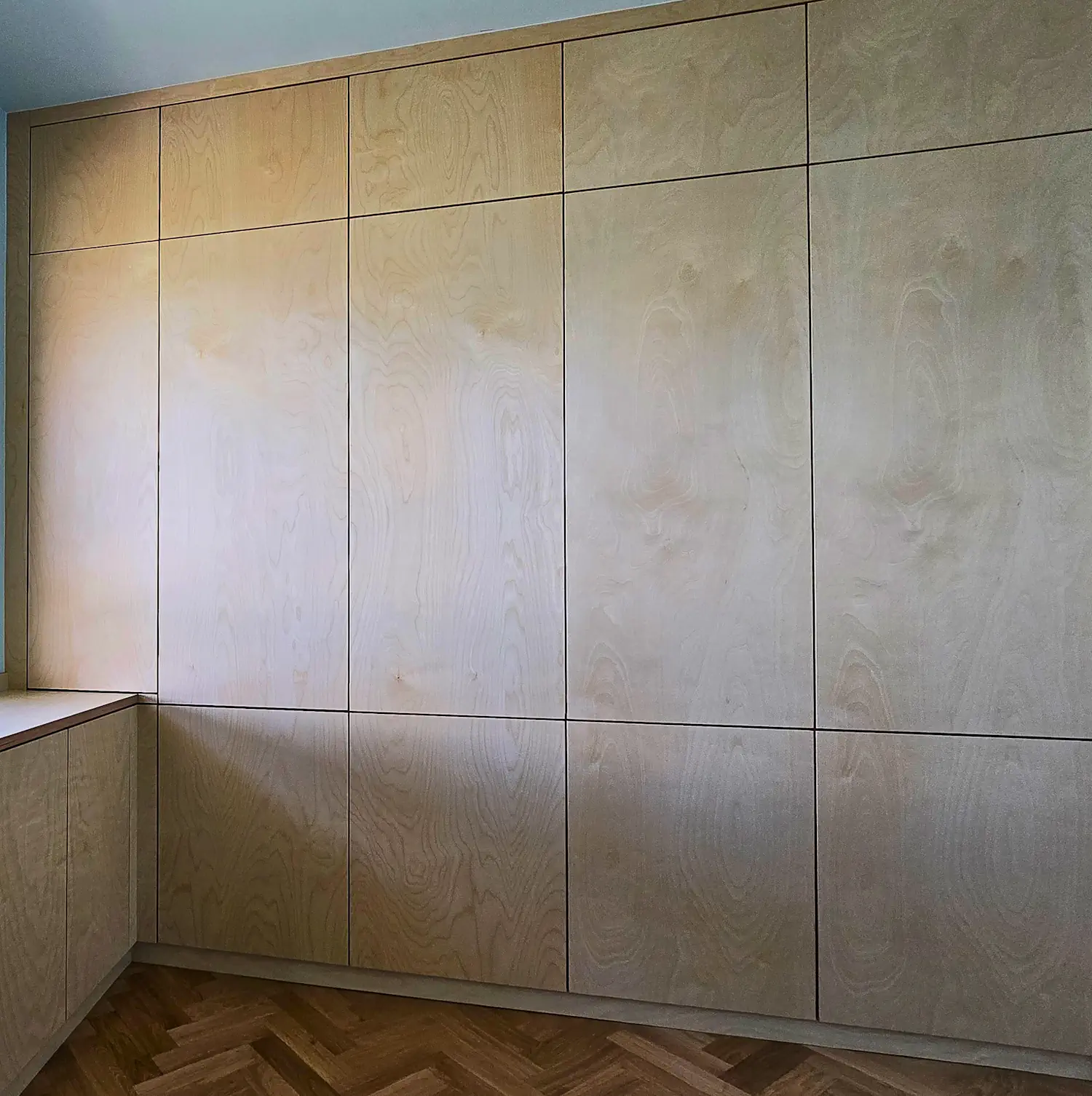
If your kitchen uses a clear finished veneer, one of the biggest visible differences between modular production and true bespoke furniture is grain matching.
Many suppliers cut fronts from available sheets with no overall composition. Doors might look fine individually, but the full run can feel random once everything is installed, especially on tall banks and large island faces.
With fully bespoke manufacturing, we can plan the veneer layout as a single visual composition across the whole scheme. That means we deliberately sequence and align the grain so it flows naturally across:
- Tall cabinet banks
- Island faces
- Long base runs
- End panels and feature panels
This approach produces a calmer, more architectural look. It is subtle, but it is one of the details that makes a veneered kitchen feel properly premium rather than assembled from unrelated panels.
Grain matching is also easier to control when we manufacture everything from scratch, because cabinet widths, door sizes and panel splits are designed around the space rather than forced by factory increments.
If you would like to see examples of veneered kitchens where this detail matters, explore our Luxury Hand Made Bespoke Kitchen Furniture page.
Who Fully Bespoke Furniture Is Best Suited To
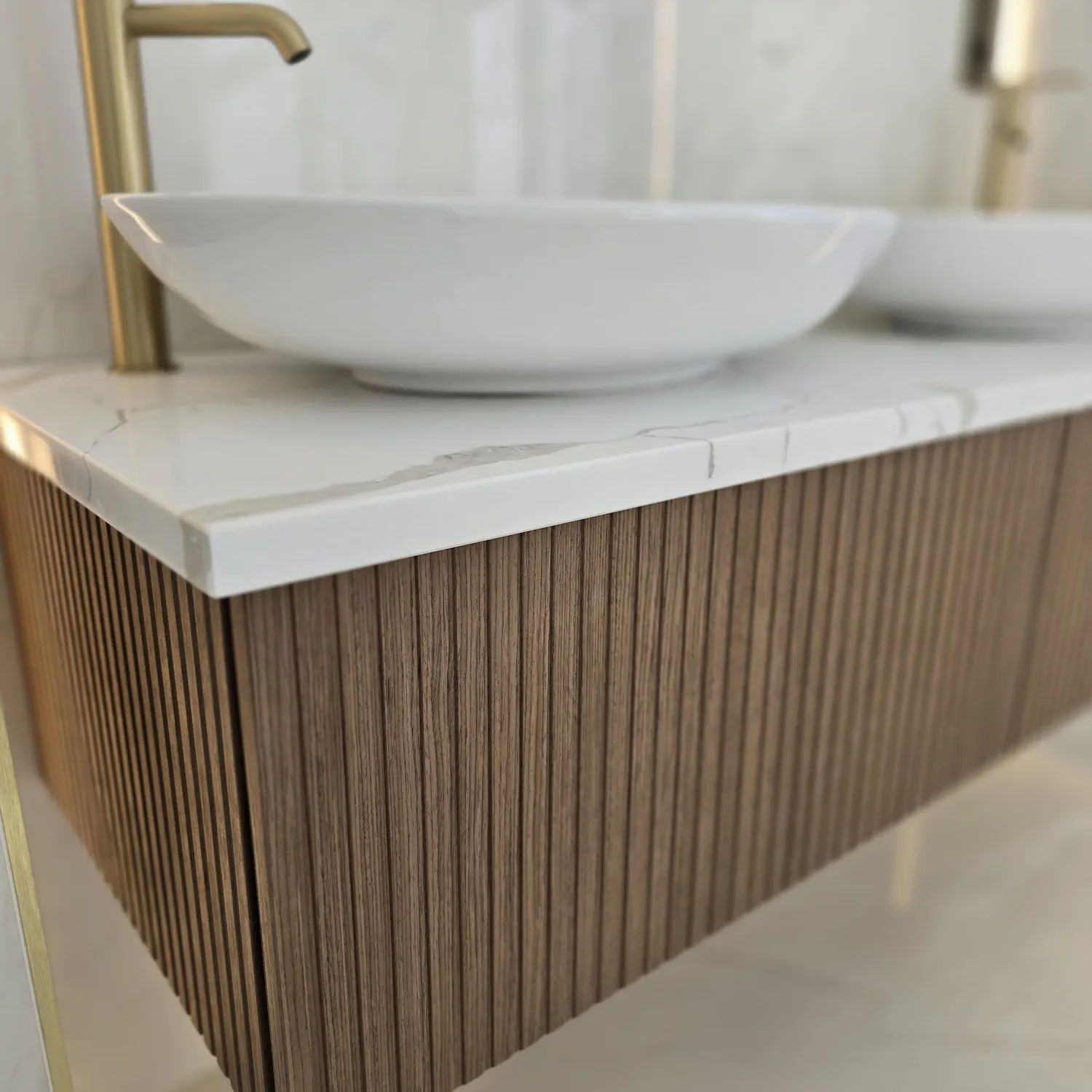
This approach is best suited to clients who:
- Value design control over catalogue choice
- Care about material integrity
- Want architectural alignment
- Prefer precision over compromise
- Understand long-term investment value
If your project includes wardrobes or fitted cabinetry beyond kitchens, see
Fitted Wardrobes for examples.
What Happens If You Decide To Proceed
Ordering Process
If the approach outlined here resonates, the next step is structured clearly.
We begin with:
- Initial consultation
- Design deposit to initiate development
- Technical refinement
- Material confirmation
- Production scheduling
The full step-by-step process is outlined here:
How To Start Your Project With Us.
Frequently Asked Questions
Is bespoke always more expensive than modular kitchens?
Not always. It depends on materials and complexity. However, fully bespoke manufacturing typically sits above entry-level factory systems.
Can you match a specific budget?
Yes. Specification can be adjusted to align with budget priorities while maintaining structural integrity.However expectations in terms of budget and specification should be realisitic
Do you only manufacture locally?
We are based in Wakefield, West Yorkshire, but we deliver our furniture across the whole UK and occasionally to other European countries and around the world if shipping costs are reasonable for the customer.
Can I visit the workshop?
Yes, and we strongly recommend that for the custoemrs who would like to see samples of materials or our projects in progress. Workshop visits are possible during the design or production stages by arrangement.
Final Thought
Choosing bespoke is ultimately about alignment — between space, materials, craftsmanship and expectations.
For some projects, a modular system is perfectly adequate. For others, precision and material integrity matter more than convenience. The key is understanding which category your project falls into.
If you believe your space deserves a more considered approach, the next step is a structured conversation.
Arrange an initial consultation and we will assess the scope, priorities and budget range openly and realistically.
Or contact us directly to schedule a video call or workshop visit.
Clear expectations at the beginning lead to better outcomes at the end.